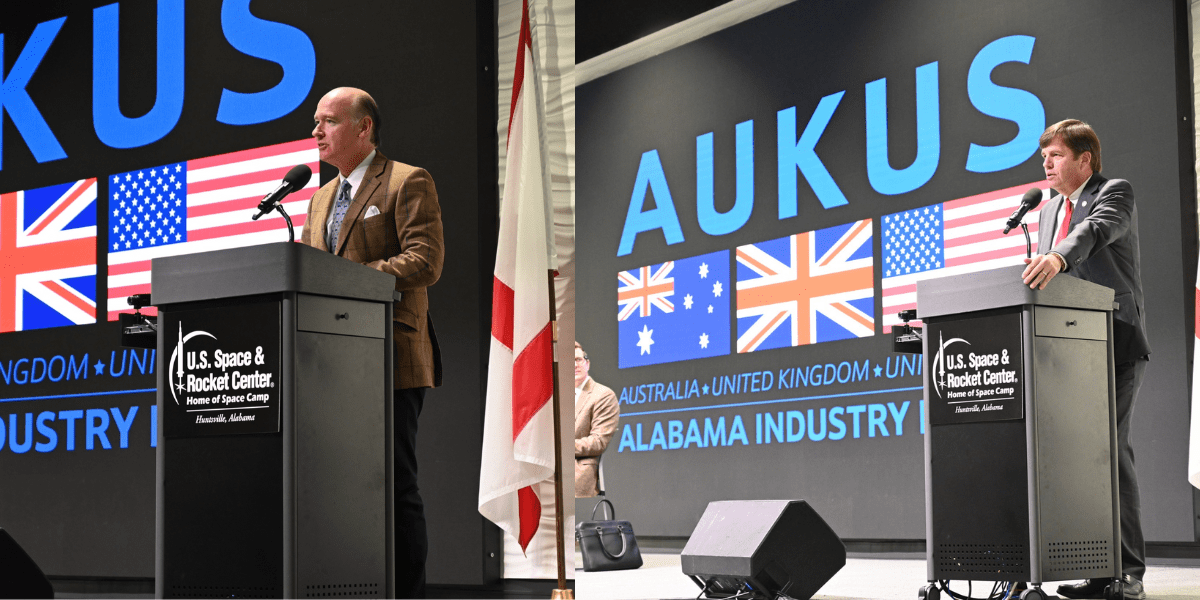
U.S. Rep. Robert Aderholt hosted the second annual AUKUS Defense Industry Forum at the U.S. Space and Rocket Center last week, convening defense and national security leaders from Australia, the United Kingdom and the United States to discuss allied defense cooperation, emerging military technologies and Alabama’s role in future security efforts.
U.S. Rep. Dale Strong (R-Huntsville) also participated in the forum, highlighting North Alabama’s position as a hub for defense, aerospace, and national security activity.
The event builds on Aderholt’s inaugural AUKUS gathering held in 2024 and continues an effort to connect defense experts and industry leaders involved in the trilateral security partnership.
“Huntsville is the Rocket City — the town that helped win the space race — and today, the men and women shaping the future of defense cooperation and deterrence are gathered right here in Alabama,” Aderholt said. “AUKUS is about maintaining a free and open Indo-Pacific, but at its core it reflects something even deeper: trust among allies. That trust must now be translated into real capabilities, delivered with urgency.”
Strong emphasized North Alabama’s strategic importance to allied defense innovation, particularly under AUKUS Pillar Two, which focuses on advanced defense capabilities.
“There are few better places to bring the stated goals of AUKUS Pillar Two to life than North Alabama and Redstone Arsenal,” Strong said. “Our region has long been a key national security player, and this trilateral agreement is no different. This second annual forum is just another example of how Alabama continues to lead the way in increasing defense cooperation, innovation, and information sharing between the United States and our allies.”
Aderholt said the advanced capabilities central to AUKUS align with work already underway across Alabama’s defense and technology sectors, including cyber operations, artificial intelligence and autonomy, quantum technologies, undersea capabilities, hypersonic and counter-hypersonic development, electronic warfare, innovation, information sharing and deep space radar.
He also warned that outdated processes and bureaucracy could slow progress at a time when speed and innovation are increasingly critical to national security.
“The tools that won the 20th century could cost us victory in the 21st if we fail to adapt,” Aderholt said. “Bureaucracy is a luxury we can no longer afford. AUKUS can help drive a new way of doing business — moving faster, thinking bigger, and delivering results with the urgency this moment demands.”
Aderholt, a member of the House Appropriations Committee and the Defense Subcommittee on Appropriations, said Congress has a responsibility to ensure the Department of Defense has the flexibility needed to plan, fund and field joint capabilities while maintaining accountability.
During the event, Aderholt also introduced Alabama native Major General Terry Grisham, who has been selected to lead the transition of U.S. Space Command from Colorado Springs to Huntsville.
“Alabama has long been at the forefront of America’s defense and space leadership,” Aderholt said. “With Major General Grisham’s leadership, our state will continue to play a critical role in the next chapter of national security and space operations.”
The forum reaffirmed Huntsville’s role as a national hub for defense innovation and highlighted Alabama’s growing involvement in emerging technologies tied to U.S. and allied deterrence efforts.
Sherri Blevins is a reporter for 256 Today.