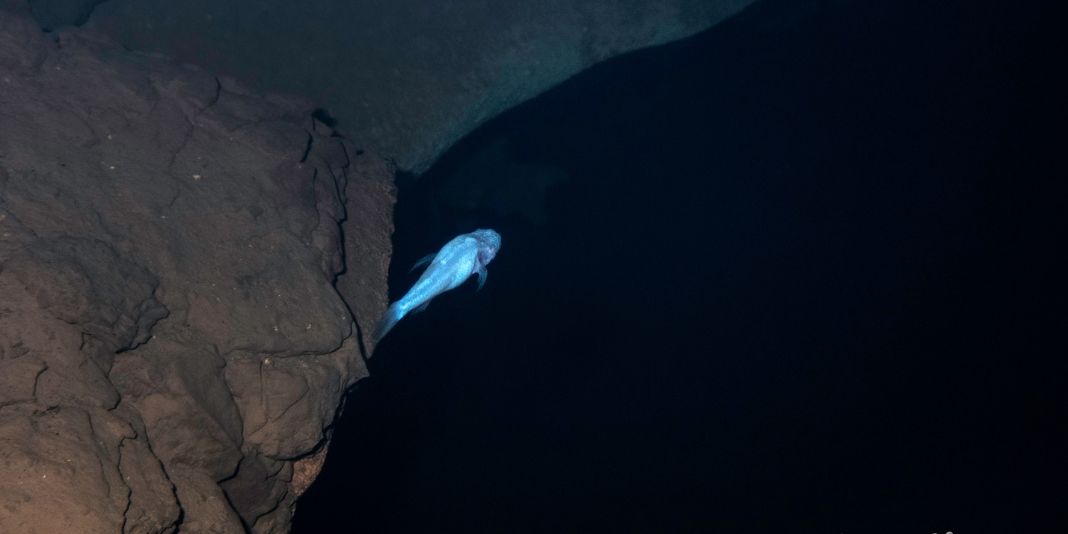
Researchers at The University of Alabama in Huntsville have identified a new genus of blind cavefish living in one of North Alabama’s most extensively studied cave systems, a discovery that is changing scientists’ understanding of cavefish evolution and the hidden biodiversity beneath North Alabama.
The newly described Demon Cavefish (Demogorgonichthys arcanus) is completely eyeless, colorless and appears faintly electric blue while alive. The discovery was published in the journal Scientific Reports.
The study was led by Dr. Matthew L. Niemiller, associate professor in the Department of Biological Sciences and director of the Cave Bio Lab at UAH, in collaboration with researchers from Auburn University, The University of Alabama, Mississippi State University, Redstone Environmental and students from the Cave Bio Lab.
“This is one of the last places we’d have bet on it,” Niemiller said. “Finding an entirely unknown, new genus of freshwater fish in eastern North America today is a little like finding a new kind of big cat. The group is so well known, we thought the big surprises were behind us. To have one turn up in a cave we’ve watched for three decades is a real reminder to stay curious.”

The fish was discovered in Bobcat Cave, located beneath Redstone Arsenal about eight miles from the UAH campus.
According to Niemiller, the cave has been monitored at least quarterly for more than 30 years, making the discovery particularly unexpected.
“This is a site that has been monitored at least quarterly for more than 30 years,” he said. “To find one—not in some remote, unexplored cave, but in Bobcat Cave—was humbling.”
Researchers said the Demon Cavefish remained undiscovered because it closely resembles the Southern Cavefish (Typhlichthys subterraneus), another blind species already known to inhabit the cave. Detailed anatomical studies, CT imaging and DNA analysis ultimately revealed it was an entirely different lineage.
“It’s distinct on every line of evidence we examined,” Niemiller said. “A new genus is warranted when an animal simply doesn’t fit within any existing one.”
The discovery also revealed that the Demon Cavefish and Southern Cavefish occupy the same underground pools despite not being closely related. Instead, the two species independently evolved similar cave adaptations, including the loss of eyes and pigmentation, millions of years apart.
“The Demon Cavefish shares its cave, and the very same pools, with the Southern Cavefish, yet the two aren’t close relatives,” Niemiller said. “Each found its own separate way into the underground world and lost its eyes and pigment independently.”
Researchers say the finding is a striking example of convergent evolution, in which unrelated species develop similar traits because they adapt to the same environment.
The fish’s scientific name reflects both mythology and its hidden existence. The genus name, Demogorgonichthys, references the mythological Demogorgon, an underworld figure also familiar to many through Dungeons & Dragons and the television series Stranger Things. The species name, arcanus, means “hidden” or “secret.”
Niemiller said the discovery also underscores how much remains unknown beneath North Alabama’s landscape.
“North Alabama sits atop one of the richest cave landscapes in the country, and the life in its groundwater is remarkable and still incompletely cataloged,” he said. “The Demon Cavefish is a reminder that our inventories are far from finished, even in well-explored places.”
The researchers say the newly identified species is currently known from only Bobcat Cave and its connected aquifer, making it particularly vulnerable to changes in groundwater quality. While Redstone Arsenal’s restricted access provides protection from human disturbance, contaminants, sediment and changes in water flow from the surface remain potential threats.
“Being known from a single cave and its aquifer makes it inherently vulnerable,” Niemiller said. “What protects it is protecting the water, including safeguarding groundwater quality and the recharge basin, not just the cave passage.”
Researchers say the discovery provides a rare opportunity to better understand how different species independently adapt to extreme subterranean environments while highlighting the importance of continued exploration and conservation of Alabama’s cave ecosystems.
Got a tip for OTR? Send your tip to [email protected] with related photo/video, your name, phone number, and e-mail address.