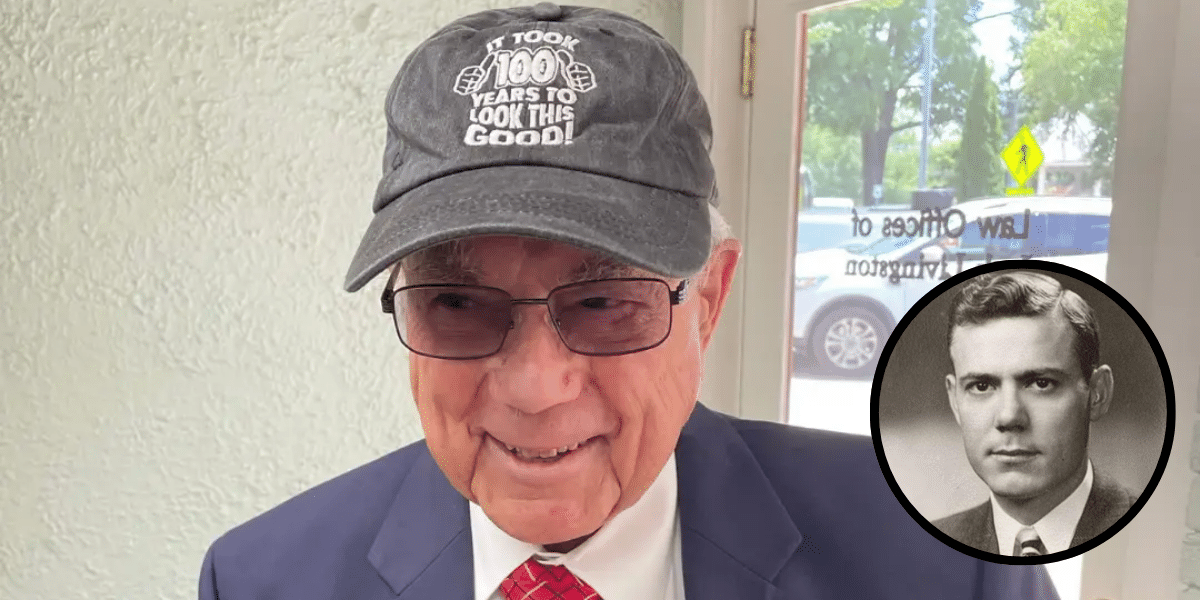
At 100, Jack Livingston still enjoys going to work. The Scottsboro attorney has spent decades helping people through difficult situations, and he remains grateful for his career – and the life it has given him.
The University of Alabama School of Law recently recognized Livingston, a 1950 graduate, as Alabama’s oldest practicing lawyer. When he was asked to reflect on his profession, he had no regrets.
“The practice of law is extremely honorable. It’s been a career that I would not change,” Livingston told the university.
He served in the Navy during World War II and later in the Army during the Korean War. His career has also included time as a circuit judge and work helping develop rules Alabama lawyers still use today. But when he talks about the people who shaped his life, he starts with his parents.
Livingston grew up on a cotton farm near Centre in Cherokee County. Cows needed milking and livestock needed feeding before and after school, and the chores didn’t stop for the weekend.
In a 2015 Jackson Magazine profile, he reflected on those early lessons, the decisions he made for his family and the importance of helping younger lawyers.
“My parents were extraordinarily good people, and they both were hard workers,” he said.
Livingston joined the Navy at 17 and served as a radar operator in the Pacific during World War II. After earning his law degree, he served stateside in the Army during the Korean War, working as an instructor and on court-martials.
He then returned to Cherokee County to practice law. Winning his first jury trial helped him earn a reputation beyond being someone his neighbors had watched grow up.
“That made my reputation in the local community a little bit better than just a homeboy,” he told Alabama Law.
Livingston was appointed a circuit judge in 1963. He later joked that his time on the bench amounted to a second law degree.
But the job also kept him away from his wife and children, and he was missing things he wanted to be there for.
“I had two children at that time, and I felt like my primary obligation was to my family,” he recalled in the earlier interview. “I was away from my family, and it was a hardship on my wife. I missed a lot of things my children were involved in. I thought it best to go back to practicing law than staying on the bench.”
He returned to private practice in Scottsboro in 1966. His children are retired educator Susan Livingston and Alabama Senate Majority Leader Steve Livingston.
Scottsboro offered opportunities for his work and a good place to raise his family. He stayed, building a practice and becoming part of the community.
“You couldn’t pick a better place to live than where we live,” he said.
His experience eventually helped shape the way other Alabama lawyers practiced. In 1971, Alabama Supreme Court Chief Justice Howell Heflin asked him to serve on the committee that recommended the Alabama Rules of Civil Procedure.
More than half a century later, Livingston told the university, “we still call them the new rules.”
He also believed the things he had learned were worth sharing. In the 2015 interview, he explained why younger lawyers were always welcome to stop by.
“I’ve always told all of the lawyers that practice here or in neighboring counties that my door is open any time if they want to come talk to me about something,” he said. “I think it’s an older lawyer’s duty to share their experience with the younger ones.”
The people who worked alongside Livingston celebrated that example when they gathered at the Jackson County Courthouse on Aug. 14 to mark his 100th birthday.
“None of us could have possibly had a better example,” Jackson County Circuit Judge John H. Graham said during the celebration, according to a report from The Clarion.
Scottsboro proclaimed the date Jack Livingston Day, and the Jackson County Commission also honored his service.
The celebration continued with a separate gathering at his church, where his son brought together a few hundred friends, according to Alabama Law. Livingston also received recognition from Alabama’s governor and a flag flown over the U.S. Capitol for his birthday.
First Southern State Bank honored Livingston with a birthday celebration earlier on September 10. Livingston has the title Director Emeritus and was joined by former and current Board of Director members, bank officials, and his son in honor of his leadership, vision, and dedication shown throughout his life.
After so many years in court, Livingston has plenty of stories to tell. One he shared with the university involved three jury trials scheduled for the same Monday – one in federal court, one in DeKalb County and another in Scottsboro.
He tried one, settled another and obtained a continuance for the third. He credited his ability to work with other lawyers and judges for getting it all sorted out.
His sense of responsibility has extended beyond the courtroom. He has also spoken about remembering veterans’ sacrifices and helping younger generations understand the importance of their service.
Now, he may soon have more time away from his desk. During his birthday celebration, Livingston told WAFF he planned to retire at the end of the year.
For someone who has spent so much of his life working with people, seeing them come back to celebrate with him meant a great deal.
“It’s extraordinarily nice to see these people,” Livingston told the station. “I am very flattered that they would take time to come and visit with me.”
Sherri Blevins is a reporter for 256 Today.
Got a tip for OTR? Send your tip to [email protected] with related photo/video, your name, phone number, and e-mail address.