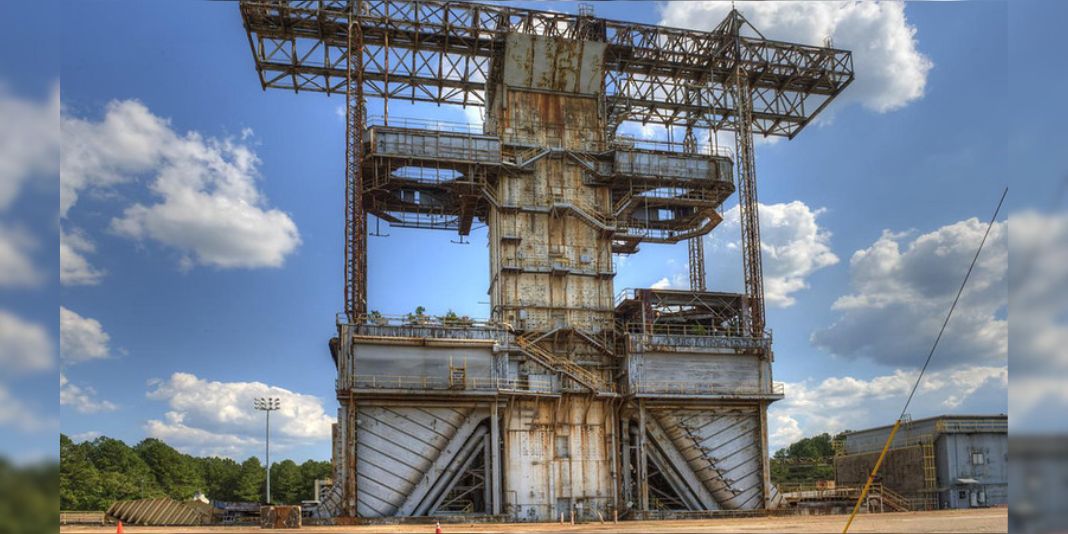
When two of NASA Marshall Space Flight Center’s most iconic test towers came down in January, the implosions marked the end of an era in Huntsville.
But thanks to a collaboration with Auburn University, they did not disappear without a trace.
On Jan. 10, NASA conducted carefully coordinated implosions of the Propulsion and Structural Test Facility, known as the T-Tower, and the Dynamic Test Facility, sometimes called the rocket shaker. The demolitions were part of Marshall’s long-term campus modernization effort aimed at removing aging infrastructure and preparing for the next era of deep space exploration.
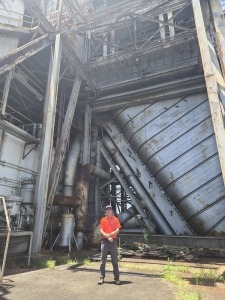
Before the dust settled, however, Auburn University professors Junshan Liu and Richard Burt had already captured the structures in extraordinary detail.
Saving history before it vanished
The T-Tower, built in 1957, supported development of the Saturn family of rockets, including the Saturn V that carried Apollo astronauts to the Moon. The Dynamic Test Facility, completed in 1964, once stood more than 360 feet tall and was used to simulate the violent vibrations rockets endure during launch.
Both facilities were designated National Historic Landmarks in 1985.
When Liu and Burt learned last fall that the towers would be demolished, they moved quickly.
Under a Space Act Agreement with NASA, the team used terrestrial laser scanning, 360-degree photography, and photogrammetry to create high-resolution digital archives of the towers, along with the Neutral Buoyancy Simulator, which crews began dismantling in December 2025.
“We were really fortunate to hear about it when we did,” Liu said. “It gave us enough time to digitally document these significant historic structures.”
The work goes beyond static preservation. The Auburn team is combining the digital scans with NASA archival materials, including historical photographs, technical schematics, and oral histories, to create interactive virtual tours that could eventually be accessible to the public.
Part of a larger modernization effort
The implosions were the most visible phase of a broader infrastructure project underway at Marshall since 2022. NASA officials have said the effort targets inactive, aging facilities that have reached the end of their operational life.
In total, roughly 25 outdated buildings, along with abandoned slabs and tanks across the center, are slated for removal.
The goal is to reduce long-term maintenance costs, improve safety, and reshape the campus into what NASA describes as a more dynamic, interconnected center ready to support Artemis missions and future deep space programs.
Clearing obsolete infrastructure allows room for modern test capabilities, upgraded laboratories, and facilities aligned with today’s propulsion systems and space exploration architecture.
A city built on rocketry
For Huntsville, the towers weren’t just steel and concrete, but physical reminders of the Saturn era and skyline silhouettes that defined Marshall’s role in winning the Space Race.
The T-Tower was the first permanent test stand at Redstone Arsenal. The Dynamic Test Facility once housed a fully assembled Saturn V rocket. Later, it supported space shuttle stack testing.
Liu said documenting the structures felt deeply meaningful.
“Their team was incredibly supportive and passionate about the history,” he said. “It felt incredibly special to help document such an important piece of American history.”