Problem solving over problem spotting. Relationships over transactions. Purpose over comfort. And whatever you do, proofread your résumé.
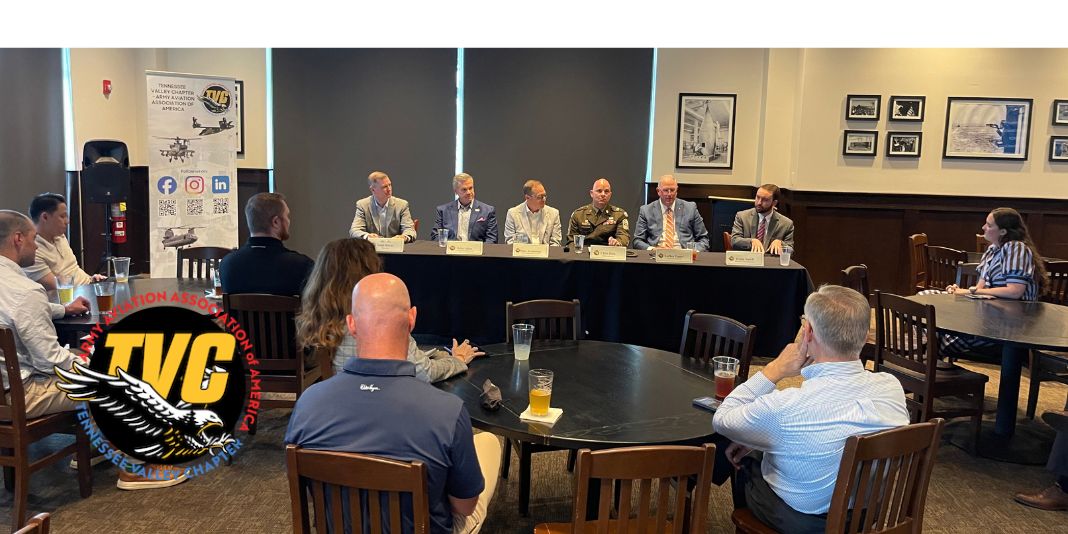
The Tennessee Valley Chapter of the Army Aviation Association of America brought together leaders from the Army, defense industry, government and community leadership at Rocket City Tavern last week to give young professionals the kind of career advice people often learn only after years on the job.
The panel featured John Allen, CEO of the Huntsville Committee of 100; Ross Armstrong, acting director of the Systems Readiness Directorate at the U.S. Army Combat Capabilities Development Command Aviation & Missile Center; Command Sgt. Maj. Chris Doss of Army Materiel Command; IronMountain Solutions CEO Luther Laney; and Dylan Smith, district director for U.S. Rep. Dale Strong.
The Tennessee Valley Chapter of AAAA serves the Redstone Arsenal, Huntsville and North Alabama Army aviation community, connecting soldiers, Army civilians, industry leaders and young professionals through mentorship, professional development and community programs. The chapter has also been recognized nationally as AAAA’s Super Chapter of the Year.
The career panel put that mission into action, giving emerging professionals direct access to leaders from across Huntsville’s military, industry, government and civic communities and a candid look at lessons they have learned along the way.
For 28-year-old mechanical engineer Dominic Durant, that access matters. He said engineers can sometimes struggle to find mentors and professional connections because of the nature of the work.
“Finding a group of professionals that you can relate to, ask questions, kind of calculate the trajectory of your future, is a big advantage,” Durant said. Events like this can also introduce young professionals to opportunities they may never have considered, he said.
The panel’s conversation ranged from getting noticed early in a career and communicating complicated ideas to building relationships, changing jobs and figuring out when to take a chance.
For Doss, standing out begins with a distinction that sounds simple but can change the way an employee approaches a job.
“The key in this area is to be a problem solver, not a problem identifier,” Doss said.
Rather than simply pointing out what is not working, he encouraged young professionals to identify inefficiencies and bring forward ways to fix them. Doing that, he said, makes someone an asset to the team.
Allen took that idea beyond the workplace and into Huntsville itself.
He encouraged young professionals to look around the community for things that need doing, particularly the things nobody else has stepped forward to tackle.
“You may ask a question, ‘Why doesn’t the community do this?’ or ‘Why doesn’t the community have that?’” Allen said. “The answer may be because they’re waiting on you to stand in the gap and take some leadership role and actually do something about it.”
And, Allen added, involvement rarely goes unnoticed.
“Somebody is always watching,” he said, encouraging attendees to volunteer, plug into the community and establish a reputation beyond their day jobs.
No death by PowerPoint
Smith, who regularly sits across the table from companies explaining highly technical defense and aerospace work to Strong’s congressional office, offered one of the afternoon’s more practical lessons: Know your audience.
And spare them the 87-slide briefing.
“Death by PowerPoint is a real thing,” Smith said.
Smith said companies are most effective when they can take complicated technology and explain it in a way that someone outside the field can quickly understand. He compared it to his previous career in journalism, where the goal was to make a complicated story understandable in less than a minute.
“You want to make things digestible so the person that you’re presenting to can really have a good understanding and a good grasp of what you’re trying to convey to them,” Smith said.
Armstrong offered a similar lesson from the Army’s technical side. Before briefing a leader, he said, understand why that person is there, what matters to them and what they already know.
“It’s not hiding information,” Armstrong said. “It is truly tailoring it to where their interests are.”
Relationships still matter
For Laney, collaboration comes down to something considerably less technical.
“It’s about relationships, how you treat people. It’s that simple,” Laney said.
That means partnerships cannot work only when they benefit one side. Reputation, work ethic and how someone treats partners have a way of coming back around, he said.
“Sometimes you just gotta look out for other folks more than you look out for yourself because it’s going to come back,” Laney said.
Doss said leaders should also recognize that the subject-matter experts around them often know more about a particular problem than they do. His approach is to define the problem, bring the right people together and then listen rather than dictate a solution.
“If you do things that way, instead of dictating collaboration, you allow it to happen naturally,” Doss said.
Allen tied that same concept directly to Huntsville’s success.
“You can’t work with people that you don’t trust, and you can’t trust people that you don’t know,” Allen said.
He pointed to collaboration as a through line in the region dating back decades, with people from different organizations willing to put expertise around the same table and figure out a problem together.
Bet on yourself
Some of the most candid advice came when the conversation turned to changing careers.
Laney encouraged attendees to first decide where they actually want to go, then work backward to determine what skills, experience and relationships will get them there.
His formula was simple: attitude and effort.
“Where do you want to go? Where do you want to be?” Laney said. “You’ve got to do some introspection.”
He also urged patience, noting that doing the right work does not always produce an immediate promotion or opportunity.
Allen, whose own career has included engineering, consulting, residential construction and community leadership, offered perhaps the afternoon’s strongest case for taking a calculated risk.
“Bet on yourself,” Allen said.
Looking back, he said he would make his career changes again because each helped shape the leader he eventually became.
“Conviction doesn’t live on the same block as comfort,” Allen said. “When I tend to get comfortable in a role, I tend to start looking for something else that’s going to drive that purpose in my life.”
Be engaged
As the conversation wrapped up, the panelists offered rapid-fire advice for young professionals beginning to build their careers.
The themes were familiar by then: find mentors, volunteer, work hard, stay open to unexpected opportunities and learn from the people around you.
Smith encouraged young professionals to get outside their offices and become part of the broader Huntsville community.
“Just get engaged,” Smith said. “We have so many great professional organizations like the Chamber that make it extremely easy to network here. Just take advantage of those opportunities.”
And when the discussion turned to résumés, Smith offered one decidedly uncomplicated warning.
His biggest red flag?
“Grammatical and punctuation errors,” Smith said. “It just shows a complete lack of effort.”
That one, at least, is easy to fix.
Got a tip for OTR? Send your tip to [email protected] with related photo/video, your name, phone number, and e-mail address.