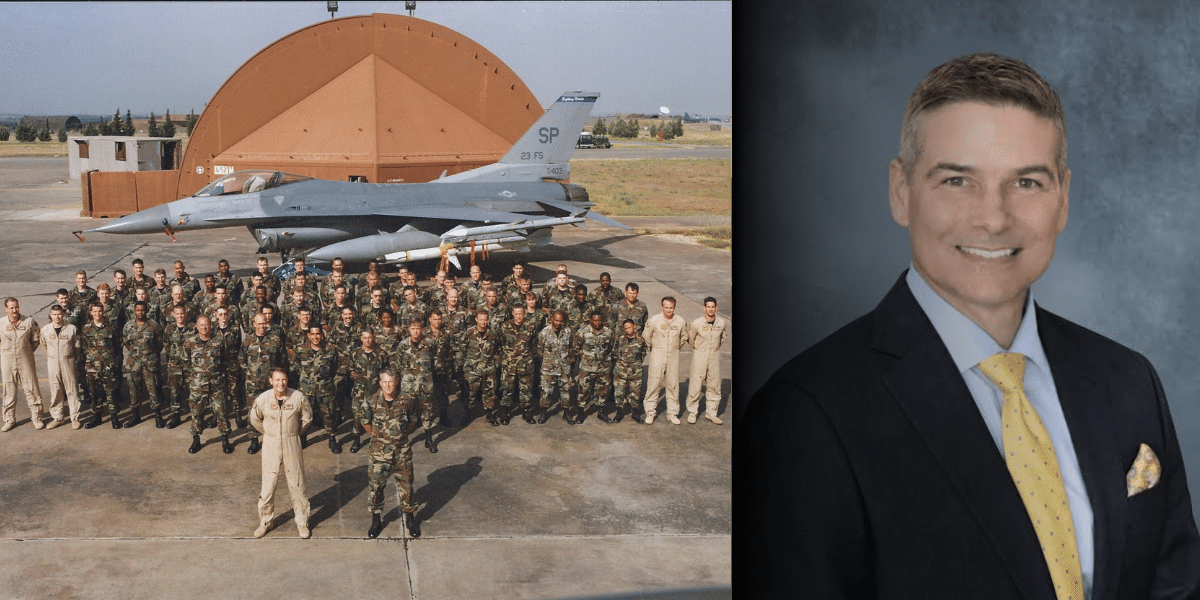
For 26 years, Ray “Buzz” Toth served his country in the U.S. Air Force, building a career that took him from the back seat of an F-15E Strike Eagle to the cockpit of fighter aircraft and eventually to command of an F-22 developmental test squadron.
As Veterans Day approaches, Toth’s reflections on his military career extend far beyond the aircraft he flew, the missions he completed, or the positions he held. Instead, he thinks about the people who made those 26 years possible, particularly those whose sacrifices often go unrecognized.
“When you get out of uniform, Veterans Day really becomes a time of remembering and being grateful for the people who made the time in service possible,” Toth said.
Today, Toth serves as vice president for integrated mission systems at Aurex, where he oversees engineering services, communications systems, and modeling and simulation efforts supporting missile defense and intelligence systems. Though his military career has ended, the lessons he learned through decades of service continue to shape his leadership, his appreciation for military families, and his commitment to supporting those who serve today.
A childhood dream takes flight
Toth’s path to the Air Force began on July 20, 1969, his third birthday, when his father sat him in front of a television to watch the first moon landing. Growing up in the Philadelphia area, Toth was surrounded by the possibilities of space exploration.
His father worked for General Electric’s Space Division, contributing to NASA programs including Landsat, Voyager, and Viking. He frequently brought home photographs from those missions, offering his son a firsthand glimpse into the technological achievements of the space program.
“I vividly remember him bringing home pictures from Voyager as it passed Saturn and as it passed Jupiter,” Toth recalled.
Visits to his father’s workplace further fueled that fascination. Seeing the computers, engineering equipment, and technology behind those missions helped Toth connect the work being done on Earth with the discoveries taking place in space. By third grade, he had decided he wanted to become an astronaut and began researching what it would take to make that dream a reality.
His pursuit eventually led him toward military aviation, where he hoped a career as an Air Force pilot could provide a pathway to space. But before his career could take flight, Toth encountered an unexpected obstacle.
Finding another way forward
During his initial physical examination for Air Force pilot training, Toth passed nearly every requirement. However, a refractive error disqualified him from entering pilot training before active duty.
“Honestly, it was devastating,” Toth said.
For someone who had spent years preparing for a career in aviation, the news threatened to derail his ambitions before they had begun. Rather than giving up, Toth began looking for another path.
He learned that the Air Force maintained different eyesight requirements for personnel already serving on active duty. If he could enter the service as a navigator, perform well, and later apply for pilot training, he might still have an opportunity to become a pilot.
Toth entered navigator training determined to earn an assignment aboard a fighter aircraft, eventually becoming a weapon systems officer in the back seat of the F-15E Strike Eagle. The experience taught him the importance of teamwork and understanding the responsibilities of those around him.
“You can’t optimize and maximize what the Strike Eagle can do if both of the people in that airplane aren’t working as a well-oiled machine,” Toth said.
Flying alongside different pilots also gave him an opportunity to observe their strengths and weaknesses, lessons he would eventually carry into his own career as a pilot. When his squadron learned he intended to apply for pilot training, many of those pilots gave him opportunities to gain hands-on experience using the aircraft’s rear-seat flight controls.
Their support helped prepare him for the opportunity he had spent years pursuing. Toth was later selected as one of five navigators across the Air Force for pilot training, news that prompted a celebration throughout his squadron.
Lessons learned through leadership
Toth’s career eventually took him from weapon systems officer to fighter pilot, test pilot, and commander of an F-22 developmental test squadron. Along the way, he developed a leadership philosophy centered on trust, accountability, and empowering those around him.
“Push as much authority and responsibility to the lowest level practical within the organization that you happen to be in, then give the people and the teams the resources and the tools they need to be successful,” Toth said.
He also emphasized the importance of mentoring individuals, recognizing their strengths and helping them find roles where their talents can be most effective. Those lessons continue to influence his work at Aurex, where he leads teams supporting complex engineering and national defense missions.
While the Air Force provided Toth with opportunities to pursue his ambitions and develop as a leader, his career also demanded sacrifices that extended well beyond his own service.
The sacrifices behind the uniform
When Toth and his wife married before he entered active duty, neither came from an immediate family with a military background, and they had little understanding of what the next 26 years would require.
Throughout his career, the family experienced frequent relocations, extended deployments and long periods of separation. During one assignment in Germany, where Toth flew F-16s, he calculated that he had been deployed for approximately 700 of the roughly 1,000 days he was stationed there. For nearly two-thirds of that assignment, his wife was left to manage their household and raise their two children without him.
“You hear about the sacrifices that the military people make,” Toth said. “Well, the sacrifices our family had to make while we were away from home, while clearly different, were no less hard.”
Toth acknowledged that while he was fulfilling a lifelong ambition, his wife was often carrying the responsibilities of two parents. His children, meanwhile, had no choice in the lifestyle into which they were born.
“I was off doing what I signed up for and what I wanted to do,” he said. “But our families didn’t always sign up for that.”
The challenges extended beyond deployments. Military assignments also meant uprooting the family, leaving behind friendships and adjusting to unfamiliar communities. Toth recalled moving his daughter from the Washington, D.C., area to Alamogordo, New Mexico, for her senior year of high school after she had spent the previous three years building friendships there.
Looking back, Toth believes those experiences helped his children become more resilient and adaptable, though he recognizes the difficulties that came with those lessons. He said military squadrons generally worked hard to support the families of deployed service members, but even the strongest support systems could not eliminate the challenges of having a parent away from home.
“Our squadrons were really, really good in general about looking after the families of folks who were deployed,” Toth said. “But again, that doesn’t replace a missing parent.”
For Toth, those sacrifices are among the most important things Americans should recognize when honoring veterans. While service members carry out their missions, their families often shoulder responsibilities and hardships that remain largely unseen.
A different meaning of Veterans Day
After retiring from the Air Force, Toth found that Veterans Day began to take on a different meaning. During his years on active duty, his attention was largely focused on the mission at hand, whether that meant preparing for the next testing milestone, leading a squadron or ensuring the people under his command had the resources necessary to succeed.
Outside the military, the holiday has become a time for reflection and gratitude. He thinks about the maintainers, engineers and young airmen whose contributions made each mission possible, particularly those operating under the demanding conditions of wartime. He also remembers those who helped shape his career, fellow service members who never made it home and his family, who carried the weight of every move, deployment and unexpected schedule change alongside him.
For Toth, Veterans Day is not simply a recognition of years served or accomplishments earned. It is an opportunity to acknowledge the countless individuals whose sacrifices often go unseen, as well as the responsibility veterans continue to carry after leaving military service.
“The uniform is in the closet now,” Toth said. “But our responsibility as veterans is to make sure our warfighters, especially in this community, have the tools to win and a path to thrive when they come home.”
That responsibility continues to guide his work at Aurex, where his military experience contributes to efforts supporting national defense.
A dream that never faded
Despite everything Toth accomplished during his Air Force career, one childhood ambition remains unfinished. He still hopes to travel to space.
The dream that began on his third birthday has never entirely disappeared, even as the path toward achieving it has changed. With commercial spaceflight continuing to develop, Toth hopes that one day the opportunity will become affordable enough for him to make the trip before his 80th birthday.
“Stay in shape, save up my pennies, and hopefully one day somebody will have a commercial rocket that I’ll be able to actually afford and be able to go fly in space,” he said.
It may not be the astronaut career he envisioned as a child, but Toth has learned that dreams do not always unfold according to plan. His own journey, from being denied entry into pilot training to eventually commanding a fighter test squadron, taught him the value of persistence and the importance of adapting when circumstances change.
He also believes there is a difference between holding on to one particular dream and maintaining the ability to dream at all. Sometimes, circumstances require a different direction, and what matters is finding a new purpose and committing to it fully.
It’s a perspective shaped by decades of military service, unexpected challenges, and the people who helped him overcome them. As Toth reflects on his 26 years in uniform this Veterans Day, he continues to emphasize the importance of recognizing the families, fellow service members, and communities who make military service possible.
When asked what advice he would give the 3-year-old boy who sat in front of the television watching the moon landing more than five decades ago, Toth didn’t hesitate.
“Dream big and never give up.”
Got a tip for OTR? Send your tip to [email protected] with related photo/video, your name, phone number, and e-mail address.