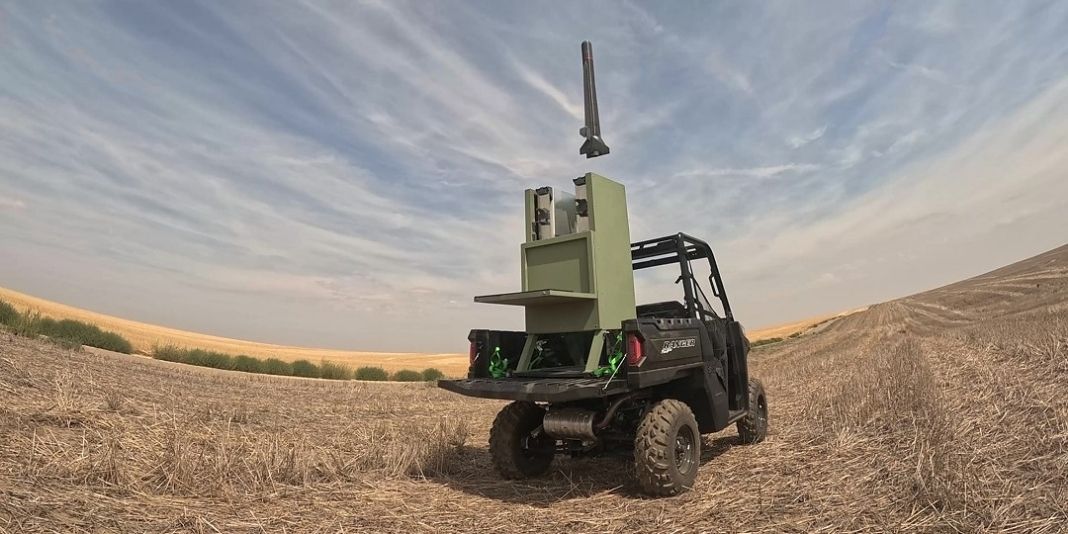
Huntsville-based Cummings Aerospace has successfully tested a new vehicle-mounted launcher for its Hellhound S3, demonstrating how a single operator can launch and simultaneously monitor multiple precision weapons against different targets.
The Aug. 25 test at the Pendleton UAS Range in Oregon marked several firsts for the company’s Hellhound program, including its first vehicle-mounted launch and the first time one operator controlled multiple Hellhounds using a single handheld fire control system.
During the demonstration, a Cummings Aerospace engineer sequentially launched two Hellhound S3 systems from a launcher mounted on a Polaris utility vehicle. Both aircraft autonomously followed preprogrammed flight paths while the operator monitored their progress in real time.
The company announced Monday that the test met all its objectives.
“This test changes the battlefield equation for our Soldiers,” said Cummings Aerospace CEO Sheila Cummings. “Instead of having to manually fly a single drone or effector to a target, one Soldier using one FCS can simultaneously put multiple Hellhounds on multiple targets.”
The Hellhound S3 is a 13-pound, turbojet-powered system roughly the size of a baseball bat. Built using 3D printing and commercially available components, it can travel more than 60 kilometers, or approximately 37 miles, at speeds exceeding 384 mph.
The company said its manufacturing approach allows it to produce more than 100 systems per month.
During the test, the operator programmed each Hellhound’s waypoints, altitude and flight path before launch. Once airborne, the systems navigated their assigned routes without manual flight control while maintaining communication with the handheld controller.
That allowed the operator to track both aircraft simultaneously and retain the ability to adjust or abort their missions.
“The S3’s speed and range enable Soldiers to compress the kill chain,” Cummings said. “Controlling several S3s from one handheld system lets a small unit produce fires that used to take an entire battery.”
The demonstration also marked the first use of a new launcher designed to carry up to eight Hellhounds and the first sequential, or ripple-fire, launch of the S3.
Although Hellhound has undergone more than a dozen flight tests in its portable configuration, the Oregon demonstration was its first launch from a vehicle.
The two systems carried inert payloads and followed different predetermined flight profiles and speeds.
Cummings Aerospace is developing Hellhound as a modular, lower-cost weapon capable of performing several missions, including precision strikes, loitering munition operations and counter-drone defense.
Its interchangeable payload modules are designed for armor-piercing, electronic warfare, decoy and blast-fragmentation missions. According to the company, the modules can be exchanged in less than two minutes without tools.
The company plans additional demonstrations involving simultaneous launches from its multi-pack launcher, including tests using unmanned ground vehicles and unmanned surface vessels.
Cummings Aerospace is also developing the larger Hellhound S4, a tube-launched system designed to reach targets approximately 130 to 140 kilometers away and remain airborne for more than 90 minutes.
Headquartered in Huntsville, Cummings Aerospace is a Native American woman-owned small business specializing in missile systems, hypersonic vehicles, radar, command-and-control systems and other defense technologies.
Got a tip for OTR? Send your tip to [email protected] with related photo/video, your name, phone number, and e-mail address.