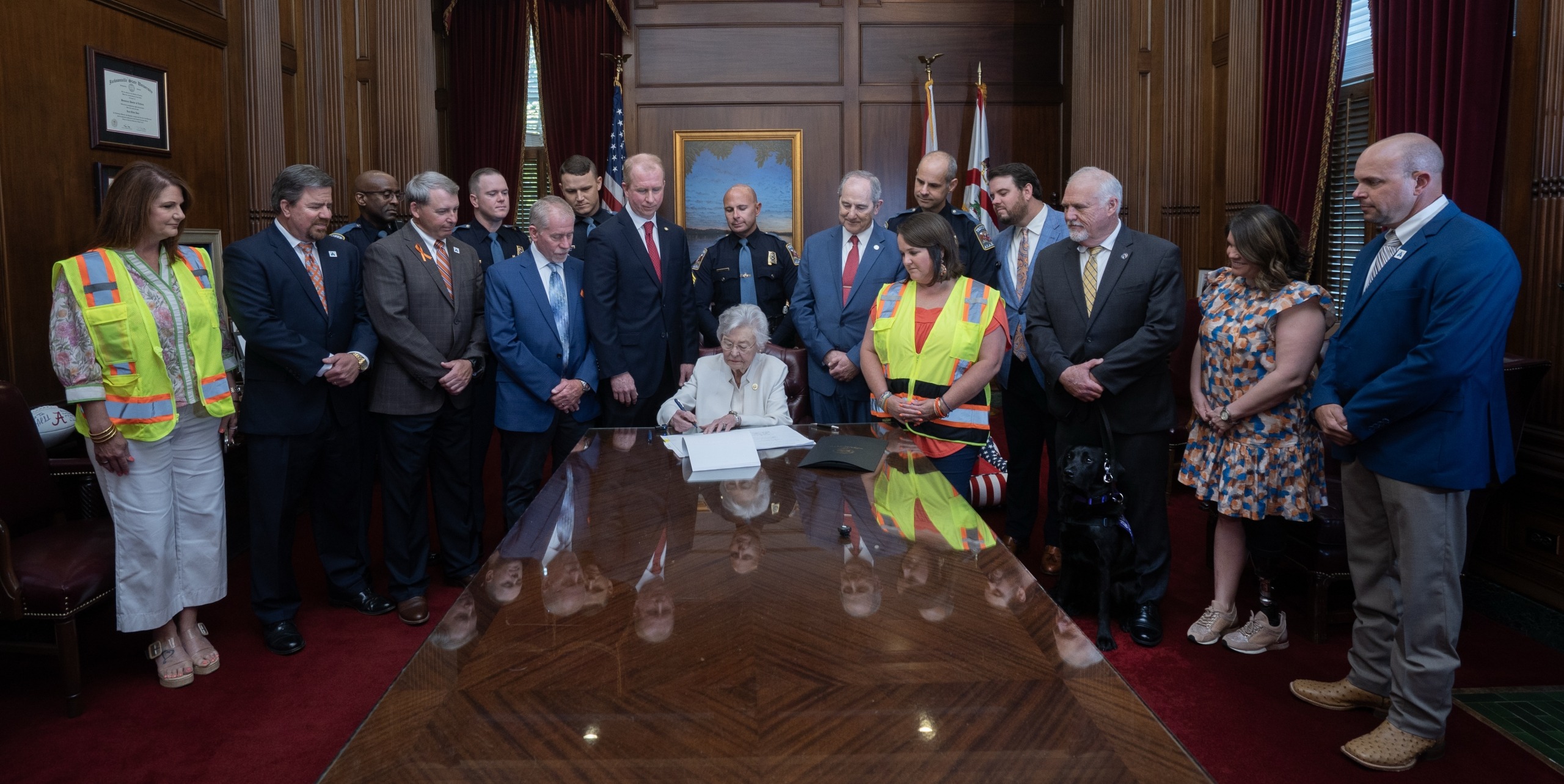
Governor Kay Ivey has signed the Alabama Work Zone Safety Act into law, establishing a new pilot program aimed at improving safety in highway construction zones as officials urge drivers to slow down and stay alert.
The legislation, Senate Bill 341, authorizes the use of photographic speed enforcement systems in interstate work zones. The measure comes ahead of National Work Zone Awareness Week, observed April 20-24, which focuses on reducing crashes and protecting roadway workers.
“Currently in Alabama, there is roadwork ongoing in all 67 counties, including on our major roadways. It is just critical that we all drive carefully through work zones,” Ivey said. “I was proud to put my signature on the Alabama Work Zone Safety Act that will help us improve safety around our roadwork and the enforcement mechanisms going forward. As we are rebuilding Alabama in all 67 counties, let’s keep the men and women doing the hard work, as well as our fellow motorists and ourselves, safe!”
The bill, sponsored by State Sen. Josh Carnley (R-Ino), and State Rep. Mike Kirkland (R-Scottsboro), also requires reports to the Legislature evaluating the effectiveness of the pilot program. A driver awareness campaign is set to launch in October, with full enforcement expected before the end of the year.
“The Alabama Work Zone Safety Act is about protecting the men and women who work hard each and every day to keep our roads safe and functional,” Carnley said. “The Alabama Work Zone Safety Act gives us a smart, data-driven approach to improving safety in some of the most dangerous areas on our roads while holding reckless drivers accountable. I appreciate my colleagues in the Legislature for their support in advancing this measure and thank Governor Ivey for her leadership in signing this important legislation into law.”
“Our highway workers deserve to return home safely at the end of every workday, and this law will help make that happen,” Kirkland added. “By implementing innovative tools to slow drivers down in work zones, we are taking a meaningful step toward preventing tragic accidents and saving lives.”
State data underscores the urgency. In 2025, Alabama recorded 2,543 work zone crashes, resulting in 11 fatalities and 709 injuries. While fatalities have declined in recent years, the total number of crashes has continued to rise.
Officials with the Alabama Department of Transportation and the Alabama Law Enforcement Agency say awareness and driver behavior remain key to improving safety.
“The number of crash fatalities in work zones in Alabama continues to decrease year after year, and the 2025 numbers are the lowest it has been in a decade,” said Dalton Middleton, Drive Safe Alabama coordinator with ALDOT. “Events like National Work Zone Awareness Week give us opportunities to bring good information to drivers and roadside workers on how to stay safe in work zones.”
“Alabama has made meaningful progress in reducing work zone fatalities, but even one life lost is too many,” said Col. Hal Taylor, secretary of ALEA. “These are not just numbers; they are families forever changed. We are proud to stand alongside ALDOT and our partners during National Work Zone Safety Awareness Week to remind every driver that slowing down, staying alert and respecting these zones protects the men and women working to improve our roadways, and everyone traveling them.”
As part of the awareness campaign, officials are reminding motorists to check traffic conditions before traveling, avoid distractions, maintain safe following distances and obey posted speed limits. Fines for speeding and other moving violations are doubled in active work zones.
Ivey has also issued a proclamation recognizing National Work Zone Awareness Week in Alabama, encouraging drivers to prioritize safety for both workers and fellow motorists on roadways across the state.