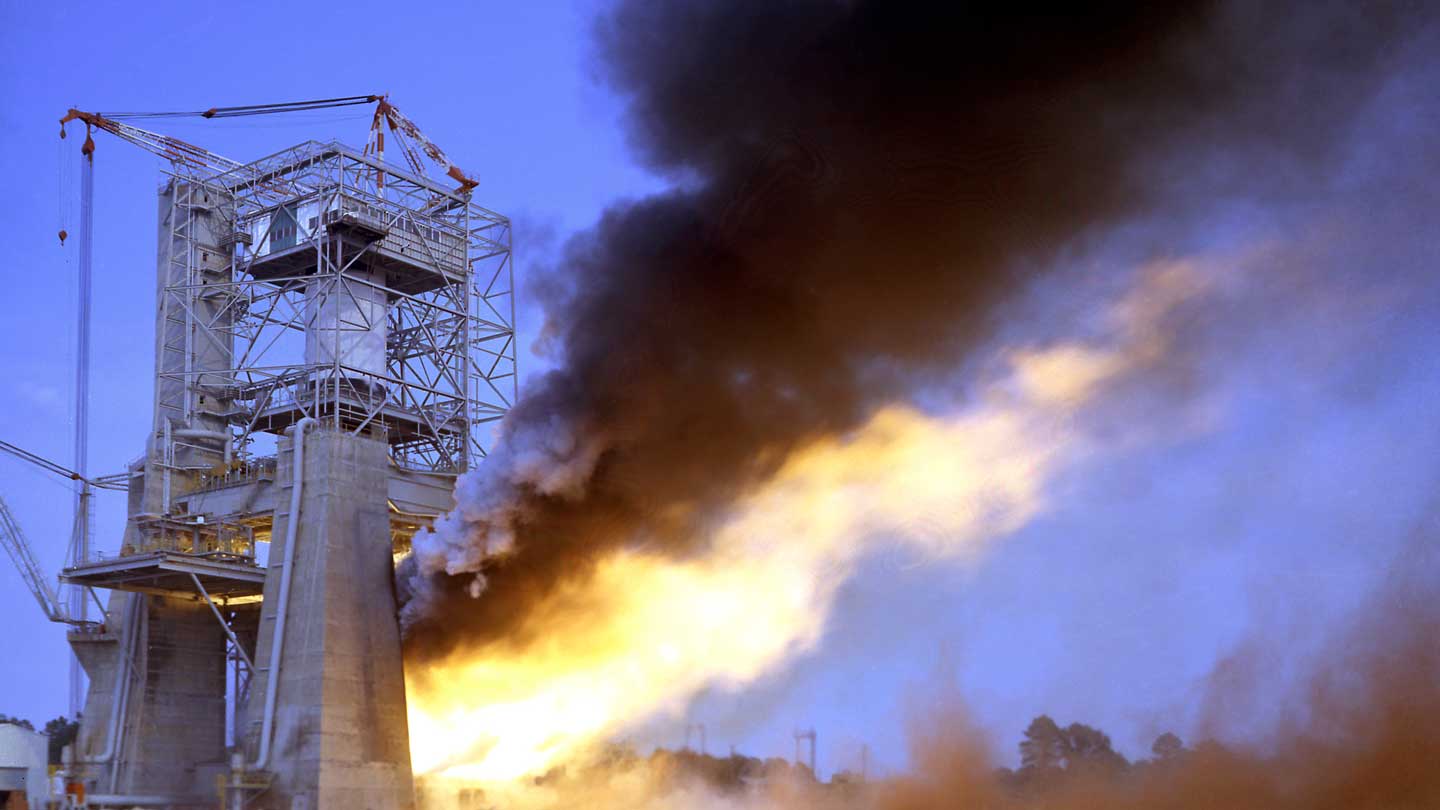
A restored Apollo-era rocket test stand and a growing partnership between NASA and Blue Origin took center stage during the 2026 Business of Space Conference at The University of Alabama in Huntsville.
The conference, hosted March 1–3 by the university’s College of Business, brought together industry leaders, researchers and policymakers to discuss the expanding commercial space economy and the partnerships shaping its future.
One of the featured discussions focused on the revival of Test Stand 4670 at Marshall Space Flight Center, a structure originally built in 1965 to test engines for the Apollo program.
Now refurbished and operated by Blue Origin through a partnership with NASA, the stand recently marked its 500th hot-fire engine test since returning to service in 2023.
“The discussion really starts on taking a dormant Apollo-era facility and revitalizing it, back to a proud national asset, to push the country forward in space exploration,” said Nick Case, formerly of MSFC’s Partnerships Office, during a conference fireside chat. “This is what happens when industry and government can truly collaborate.”
The nearly 300-foot-tall test stand supported propulsion testing for the Saturn V rocket during the Apollo-era before becoming inactive in 1998 as NASA consolidated some propulsion testing operations.
David Helderman, director of engine test operations for Blue Origin in Cummings Research Park, said Blue Origin began exploring use of the facility in 2017 as the company expanded its presence in Huntsville.
“What does success look like to you?” Helderman recalled asking early in discussions. “It couldn’t just work for NASA, it couldn’t just work for Blue Origin. It had to work for both of us.”
Under a Space Act Agreement, Blue Origin invested in restoring and modernizing the stand while NASA retained ownership of the facility.
Blue Origin opened an engine production facility in Cummings Research Park in 2020 and has grown rapidly since then.
“We started in Huntsville with an engine plant that was going to have 200 people,” Helderman said. “We’re close to 2,000 people now, roughly 10 times where we started at the beginning of this partnership.”
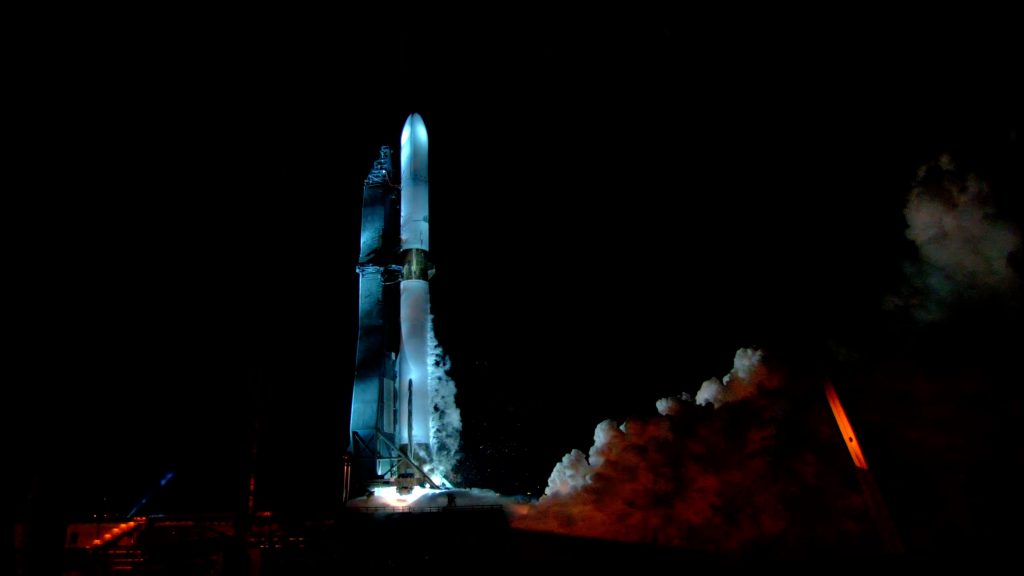
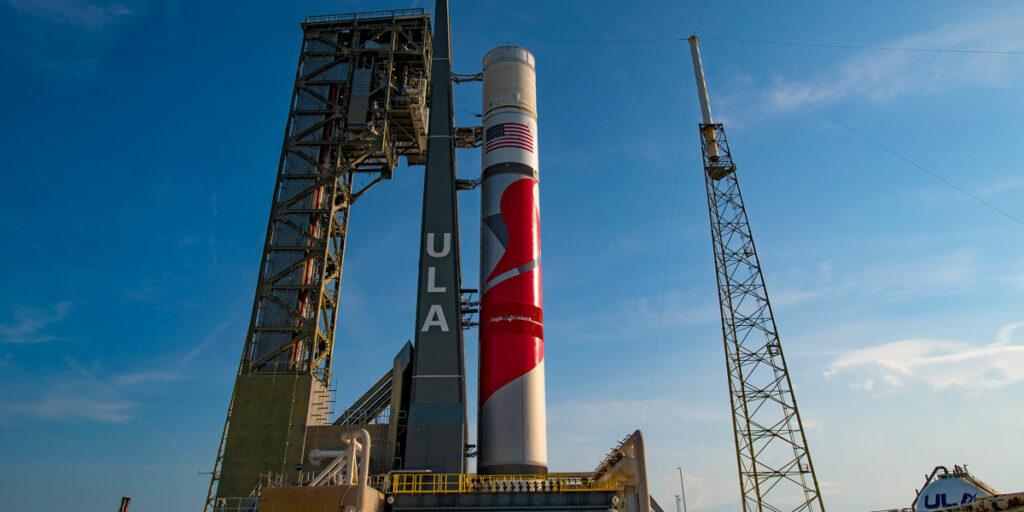
The BE-4 engine tested at the facility will power Blue Origin’s New Glenn rocket as well as United Launch Alliance’s Vulcan launch vehicle.
Speakers at the conference said the collaboration demonstrates how public-private partnerships can accelerate innovation while preserving historic national assets.
“This is not a one-off example,” Case said. “This is a model we want to employ on many other collaborations and partnerships with industry.”