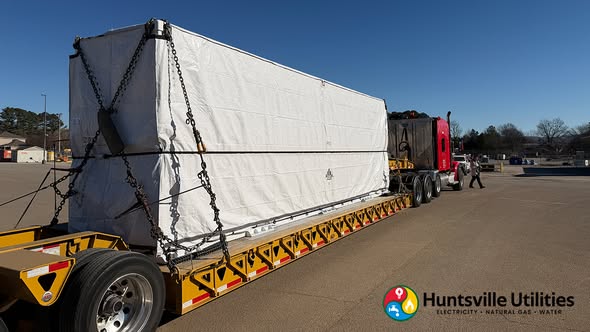
HUNTSVILLE — Huntsville Utilities has taken delivery of an 83,000-pound battery that will serve as the first grid-scale battery project of its kind in North Alabama, part of a pilot effort aimed at managing peak electric demand during extreme weather.
“It’s about the size of the back end of a semi,” said Todd Long of Huntsville Utilities. “It actually wasn’t supposed to be delivered until the summer, but they called and said they had time to send it early, so we went ahead and took it.
“Right now it’s being stored at our Triana facility while we prepare the site, which was already planned for later this year.”
The battery is part of a grid load management project funded in part by a grant from the American Public Power Association and will be installed at the Stringfield Substation near Pulaski Pike.
“This is a pilot project to learn more about how we would control the charging and discharging of the battery,” said Stacy Cantrell, Huntsville Utilities’ vice president of engineering. “We do expect to eventually install batteries at other substations.”
The battery, manufactured by Tesla, will store electricity during off-peak hours and discharge power during periods of high demand, such as extreme heat or extreme cold. The goal is to reduce stress on transformers and other grid equipment by easing overloads during peak usage.
According to Huntsville Utilities engineer Anyama Tettey, who spearheaded the grant application, the battery is rated at 2 megawatts and 4 megawatt-hours, or 2MW/4MWh, with a maximum capacity of 2,400 kVA.
“For this particular project, we do not expect to output more than 1,900 kVA during a discharge cycle,” Tettey said. “This will avoid excessive battery degradation.”
The battery will serve the portion of the electric grid connected to the Stringfield Substation, an area selected in part because it already has sufficient space and infrastructure to support the installation. It can also provide limited assistance during outages affecting that section of the system.
The $125,000 grant from the American Public Power Association covers a large portion of the cost of the system. Tettey said Huntsville Utilities will also receive tax credits tied to the installation.
“This is the first project of its kind in north Alabama,” Tettey said. “EPB in Chattanooga has a similar battery, but their use is different from what we will be using ours for.”
Installation is planned for next year, with the system expected to be operational by summer. Looking ahead, Huntsville Utilities sees battery storage as a potential long-term tool for managing growth and rising demand.
“Our goal is to shave off the peak during the on-peak period,” Tettey said. “The more batteries we have that would allow us to do that, the better. Each battery size would have to be site specific.”
The system will be charged during off-peak hours and discharged on days when peak demand is anticipated, based on weather forecasts and historical usage data, particularly during temperature extremes.