A team of University of Alabama in Huntsville students is working on a problem that could become increasingly important as NASA prepares for longer stays on the moon: how to land a spacecraft without damaging the vehicle or the equipment around it.
The team recently completed three rocket-motor firing tests on a prototype landing pad at UAH’s Propulsion Research Center. The tests showed that the design could capture and redirect rocket exhaust, potentially reducing the heat and force that threaten spacecraft and nearby structures during a lunar landing.
The research is led by Judy Schneider, a professor in UAH’s Department of Mechanical and Aerospace Engineering. It is part of a multiyear partnership with Linc Research Inc., supported by NASA’s Small Business Technology Transfer program.
On the moon, a spacecraft’s engines can kick up dust and debris at high speeds as the vehicle approaches the surface. That material can damage equipment, while the heat and force of the exhaust can put the lander itself at risk. Those challenges become more significant as NASA works toward establishing a sustained human presence on the lunar surface.
“On Earth, we use water-cooled flame buckets to redirect rocket exhaust,” Schneider said. “But we won’t have those resources on the lunar surface, where water will be in limited supply. Our goal is to redirect the rocket plume so it doesn’t damage the landing vehicle or any surrounding structures.”
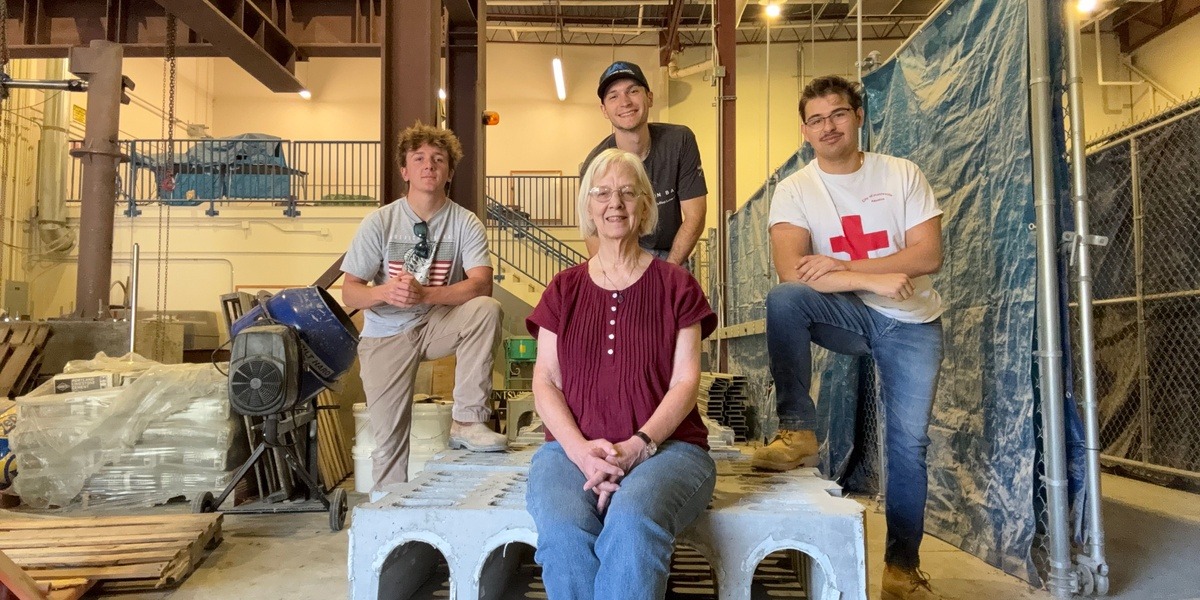
The prototype uses interlocking concrete components with vents built into the structure. Rather than forcing the entire landing pad to withstand the full blast of a rocket engine, the design channels exhaust through the vents and away from the landing area.
For the initial tests, researchers assembled a structure measuring 12 feet across. Concrete served as a stand-in for materials that could eventually be made using resources found on the moon, and sensors recorded how the exhaust moved through the vent system during three firings.
“The hot-fire tests demonstrated that we could redirect the rocket plume,” Schneider said. “By using an internally vented structure, we were able to prevent the heat from damaging the pad as it could in a solid structure.”
The project also gives students direct experience with the engineering challenges involved in space exploration. The team includes Cadis Ammons, who is completing a master’s degree in mechanical engineering, along with undergraduate mechanical engineering students Isaac Menzel and Matthew Allmon and civil engineering student Andrew Angelucci.
The modular design could eventually help make lunar construction more practical. Transporting building materials from Earth is expensive, so researchers are exploring whether landing pads could be built from processed lunar soil, known as regolith. Individual sections could also make future structures easier to assemble, expand and repair.
The next step is to build a larger prototype measuring 20 feet in diameter. The team plans to deliver it to NASA’s Marshall Space Flight Center in Huntsville for additional testing and evaluation.
The next round of tests will help researchers determine how the design performs at a larger scale and whether it can eventually support repeated spacecraft landings as NASA’s plans for the moon continue to develop.
Zachary Austin is a writer for 256 Today. You can contact him at [email protected].
Got a tip for OTR? Send your tip to [email protected] with related photo/video, your name, phone number, and e-mail address.