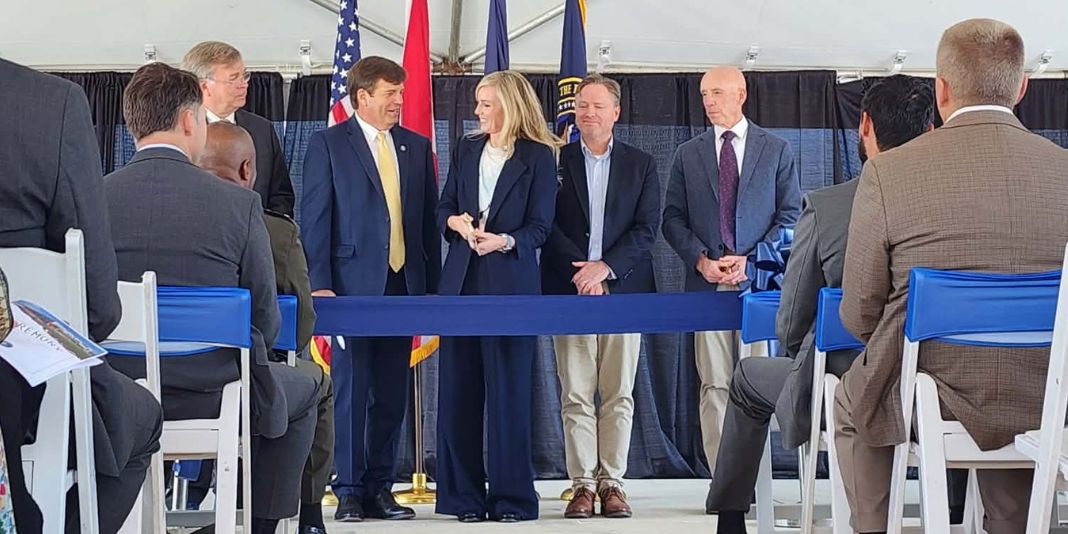
Behind the gates of Redstone Arsenal, past multiple checkpoints and tightly controlled access, a new intelligence facility has been built around work the public will largely never see.
On Tuesday, Defense Intelligence Agency leaders hosted a ribbon-cutting for the nearly 92,000-square-foot Materiel Exploitation Center, a state-of-the-art facility where analysts and engineers will study and exploit foreign weapons systems.
Only select government and military personnel were allowed inside Tuesday, a reflection of the highly sensitive work that will take place there.
“A lot of what we’ll do behind these walls is highly sensitive and we can’t get into the details,” DIA Deputy Director Sharon Rose said.
What officials could say offered a rare glimpse into a mission rooted at Redstone for seven decades. Missile and Space Intelligence Center Chief Steven Rush said the need is growing as MSIC confronts an expanding and increasingly complex array of foreign weapons systems.
“We’re responsible for over 700 weapons systems to analyze, exploit and inform the intelligence community and acquisition community for impact to the warfighter,” Rush said. “Those numbers are growing exponentially every day and complexity combined.”
“This facility is already in the fight supporting operations in Iran, operations to counter Russia and Ukraine and elsewhere in the world, and operations to counter China,” Rush said.
More than a new building
Tuesday’s ribbon-cutting marked the completion of Phase I of MSIC’s Advanced Analysis Complex, a project more than 20 years in the making.
Congress allocated more than $150 million for the first phase, which includes nine high bays for the exploitation of large foreign weapons systems, specialized scientific laboratories, secure intelligence spaces, logistics capabilities, vehicle maintenance and supporting infrastructure.
The new center expands MSIC’s capacity to analyze more than 700 foreign weapons systems, a workload Rush said is growing rapidly in both number and complexity.
“We’re responsible for over 700 weapons systems to analyze, exploit and inform the intelligence community and acquisition community for impact to the warfighter,” Rush told 256 Today. “Those numbers are growing exponentially every day and complexity combined. So this is absolutely critical in our fight today, in our future fights.”
Officials said the mission goes beyond determining how an adversary’s weapon works. What MSIC learns can help U.S. forces understand how to defeat it, tell weapons developers what capabilities American systems need and give national leaders a clearer picture of what adversaries can do.
Principal Deputy Director of National Intelligence Aaron Lukas called the new center a “key enabler” of that mission.
“This center will provide valuable insights into the capabilities and intentions of our adversaries, enabling analysts to conduct more detailed and nuanced assessments that inform decision making across the Department of War and the intelligence community,” Lukas said.
“The Materiel Exploitation Center is not just a new building,” he added. “It’s a catalyst for innovation, for collaboration, and for excellence across the entire community.”

From Vietnam to today’s threats
The concept behind materiel exploitation is not new, and Rose offered a Cold War-era example of what it can mean for the warfighter.
During the Vietnam War, Soviet MiG aircraft posed a serious threat to American pilots. In 1976, Rose said, DIA analysts at MSIC were able to get their hands on two of the aircraft.
“They took them apart. They do what we do best,” Rose said. “They identify where exactly those design flaws were. We exploited them, and we shared that intelligence.”
That intelligence was incorporated into American fighter training, including the Navy’s Top Gun program.
“Our kill ratio skyrocketed from a two-to-one ratio to a 13-to-one ratio,” Rose said.

The threats facing analysts today are considerably more complex, but Rose said the principle remains the same.
“This center expands our capacity to perform technical analysis on over 700 foreign weapon systems,” she said. “By doing technical and hands-on research, the center develops our analytic workforce, making them experts on every component and system that threatens our warfighters today and those that will come in the future.”
The intelligence developed there also helps determine what the United States develops and buys.
“This analysis informs department acquisitions, ensuring that we invest capabilities that counter those adversary threats,” Rose said.
It can also expose the flaws and limitations in an adversary’s technology, information that can be passed directly to troops who may encounter those systems in combat.
“While that’s important strategic insight for our decision makers, it is absolutely life-saving information for our troops,” Rose said. “The work that our team will do behind these walls will guarantee that our warfighters have every single advantage that we can provide them.”
A Redstone mission with 70 years of history
The work moving into the new facility has deep roots in Huntsville.
MSIC’s history stretches back roughly 70 years to missile intelligence work that began alongside Wernher von Braun’s rocket team at Redstone Arsenal. The organization evolved through several iterations before becoming part of the Defense Intelligence Agency in 1992.
Rush said that history is still tangible within the workforce.
“It is humbling and an honor to carry on this legacy of intelligence work that’s been going on for over 70 years here at the Missile and Space Intelligence Center that started with the von Braun era,” Rush told 256 Today. “We have officers whose parents and grandparents served with von Braun. We value our heritage and history and our relationship with our community partners.”
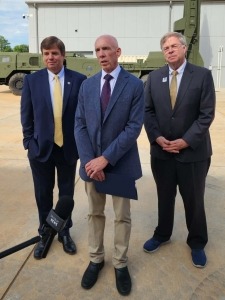
U.S. Rep. Dale Strong said the new center carries that mission into another generation.
“For nearly 70 years, dating back to Dr. Wernher von Braun’s own missile team, MSIC has been the nation’s premier source of foreign missile and space intelligence,” Strong said. “And this facility ensures that legacy continues into the next generation of strategic competition.”
Strong also pointed to what now surrounds MSIC: the Missile Defense Agency, Army Space and Missile Defense Command, NASA’s Marshall Space Flight Center and U.S. Space Command’s growing presence, all clustered in the Huntsville area.
“This kind of proximity isn’t an accident,” Strong said. “It’s exactly why Redstone Arsenal has become the place where America’s intelligence, space and missile defense communities work side by side rather than in silos scattered across our country.”
Rush said that collaboration extends across Redstone, where MSIC works with more than 60 federal partners.
“This Redstone Arsenal is an amazing installation and an amazing community of Huntsville, Alabama,” Rush said. “Here on Redstone Arsenal, we collaborate with over 60 different federal partners to deliver intelligence to the warfighters, national policymakers and the U.S.”
Even though much of what happens inside the Materiel Exploitation Center will remain out of public view, Rose said its purpose is straightforward.
“The work that our team will do behind these walls will guarantee that our warfighters have every single advantage that we can provide them,” Rose said.
“Our warfighters and our nation are safer because of the professionals who call this building home here in Rocket City.”
Got a tip for OTR? Send your tip to [email protected] with related photo/video, your name, phone number, and e-mail address.