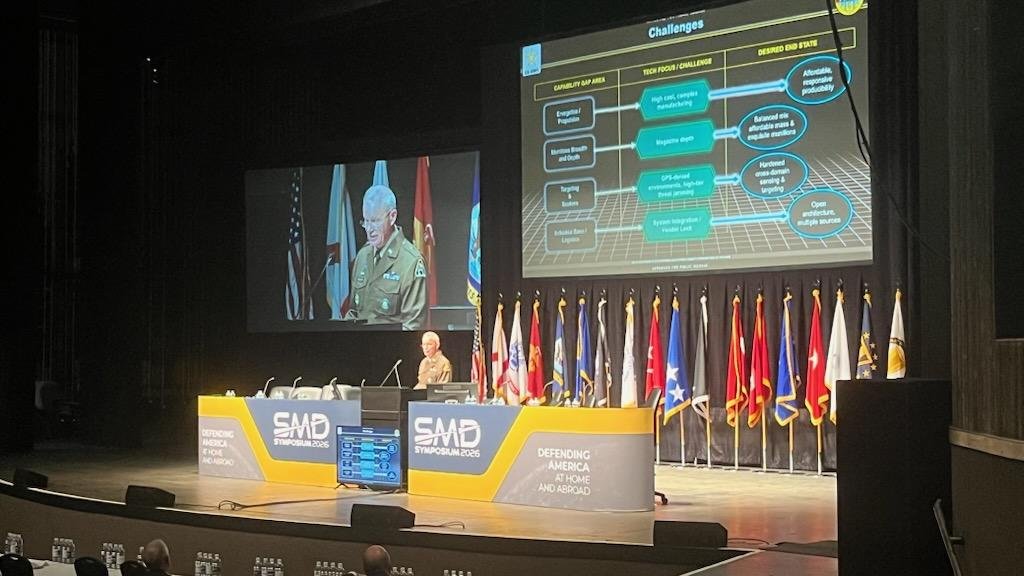
The United States is not currently equipped to respond to the kind of large-scale drone attack already being seen elsewhere in the world, a top U.S. Northern Command official warned Thursday in one of the starkest assessments of the final day of the Space and Missile Defense Symposium.
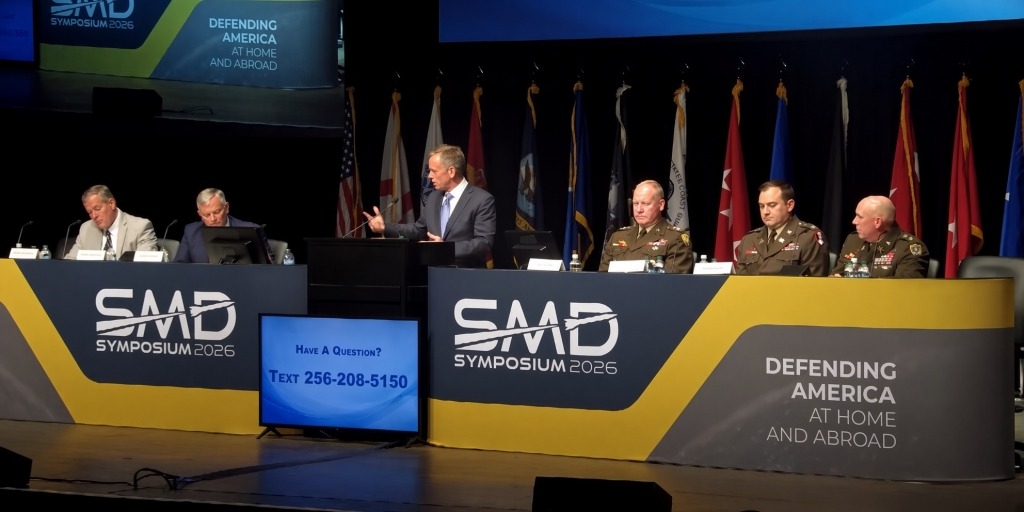
Asked whether NORAD currently has the sensors, authorities and decision-making speed necessary to respond to a swarm of inexpensive drones launched from inside or near U.S. borders, NORTHCOM Deputy Commander Lt. Gen. Joseph Jarrard gave a direct answer.
“No.”
“We are ill-equipped right now to handle something like that,” Jarrard said. “We’ve got to figure out how to mitigate that threat, but we’re not there yet.”
The admission came as Jarrard described a homeland defense environment dramatically different from the one NORAD and NORTHCOM were originally designed to confront.
“For decades, NORAD faced one threat, Russia, from one domain, the air, from one avenue of approach, the Arctic,” Jarrard said.
Today, threats can come “from sea floor to space,” he said, and include increasingly capable Russian and Chinese weapons, cyberattacks, hypersonic and ballistic missiles, unmanned aircraft systems and non-state actors.
NORTHCOM has been designated the Department of War’s lead synchronizer for counter-small unmanned aircraft systems in the homeland and is working to integrate military capabilities with federal and local law enforcement systems.
Jarrard said that interoperability will become increasingly important because protecting the homeland extends beyond military installations to cities and critical infrastructure.
Golden Dome is also reshaping that mission.
NORTHCOM is the supported combatant command for Golden Dome for America and worked with U.S. Space Command to validate its initial capabilities document. Joint Task Force Gold, led by Lt. Gen. John Rafferty, commanding general of Huntsville-based Army Space and Missile Defense Command, is working with the Golden Dome program office to align air and missile defense capabilities with operational requirements.
Jarrard said Golden Dome will require closer integration among commands and faster decisions.
“It’s going to have to be more seamless,” he said. “We’re going to have to work together better to understand and to make quicker decisions with respect to how we react to some of those threats, because they’re going to be more numerous.”
‘Every month matters’
That urgency carried into the morning’s Army PAE Fires update, where Brig. Gen. R.J. Mikesh, Capability Program Executive for Offensive Fires, told industry that adversaries are not waiting for traditional U.S. acquisition timelines.
“We need to sense earlier. We need to decide faster, shoot farther, and we need to defend deeper,” Mikesh said.
PAE Fires oversees 62 programs spanning offensive, defensive and integrated fires, with its presidential budget growing from $18 billion in fiscal 2026 to $47 billion in the fiscal 2027 request.
“That is a demand signal,” Mikesh said. “It tells us that fires are central to how the nation intends to deter aggression. And if deterrence fails, fight and win.”
But Mikesh said more money alone will not solve the problem.
The Army needs greater manufacturing capacity, resilient supply chains, open architectures and a mix of advanced weapons and lower-cost systems that can be produced in much larger quantities.
“Not every target requires the most exquisite munition, and not every threat should be defeated with our most expensive interceptor,” Mikesh said. “We need a balanced mix of affordable mass and exquisite capability.”
He also issued a direct challenge to the defense industry: design systems that can be modified, manufacture them with high-rate production in mind and bring new technologies forward rather than waiting for the government to ask.
“A beautiful prototype that takes 18 months to hand build is not the answer to mass problem,” Mikesh said.
His final message echoed a theme heard repeatedly throughout the three-day symposium in Huntsville.
“Time is a war fighting resource,” Mikesh said. “Every month matters.”
Got a tip for OTR? Send your tip to [email protected] with related photo/video, your name, phone number, and e-mail address.