Faces wrapped in boggans line the dark streets, frosty puffs of breath dissolve into the black sky. It’s late November, nineteen eighty something, and volunteers with the Moulton Business and Professional Association are organizing the chaos before the annual Christmas Parade kicks off.
Streetlights are dim, where there are any at all, and a fog of burned diesel fuel hangs over the parking lot of the local high school. Hot rods, beauty queens, horses with riders, tractors, and a collection of high school marching bands all slowly draw close and then, in a moment, there’s a proper parade. Santa sits atop the shiny red Moulton Fire Department ladder truck. The noisy caravan advances toward the town square.
(Christy Williams/Contributed)
Children strain to see through the crowd gathered at the corner of the old WPA era courthouse, searching for the spectacle they’ve waited to see since the year before. Suddenly, tiny freezing ears hear the quiet approach of what the crowded men and women are hiding from view.
The familiar thump thump thump of a bass drum, slow and booming, draws closer. Now nearer, the sharp beat of boot heels slapping pavement in unison grows louder. Silence. The drum major’s silver whistle announces the arrival.
The Courtland High School Marching Band bursts into view, rounding the corner. An explosion of white marching boots and chests emblazoned with oversized orange scripted Cs push down Court Street, brass horns cutting through the frigid air. This band knew how to keep time, but when it passed through a crowd, time kept still.
In the town of Courtland, time often slides backward before crawling forward again. Under the direction of Calvin Thompson, the Courtland High School band was known as one of the top bands in the state, despite its small size. Likewise, the CHS football team, led by Coach Louis White, is one of the most storied high school football teams in Alabama athletic history. But time marches on.
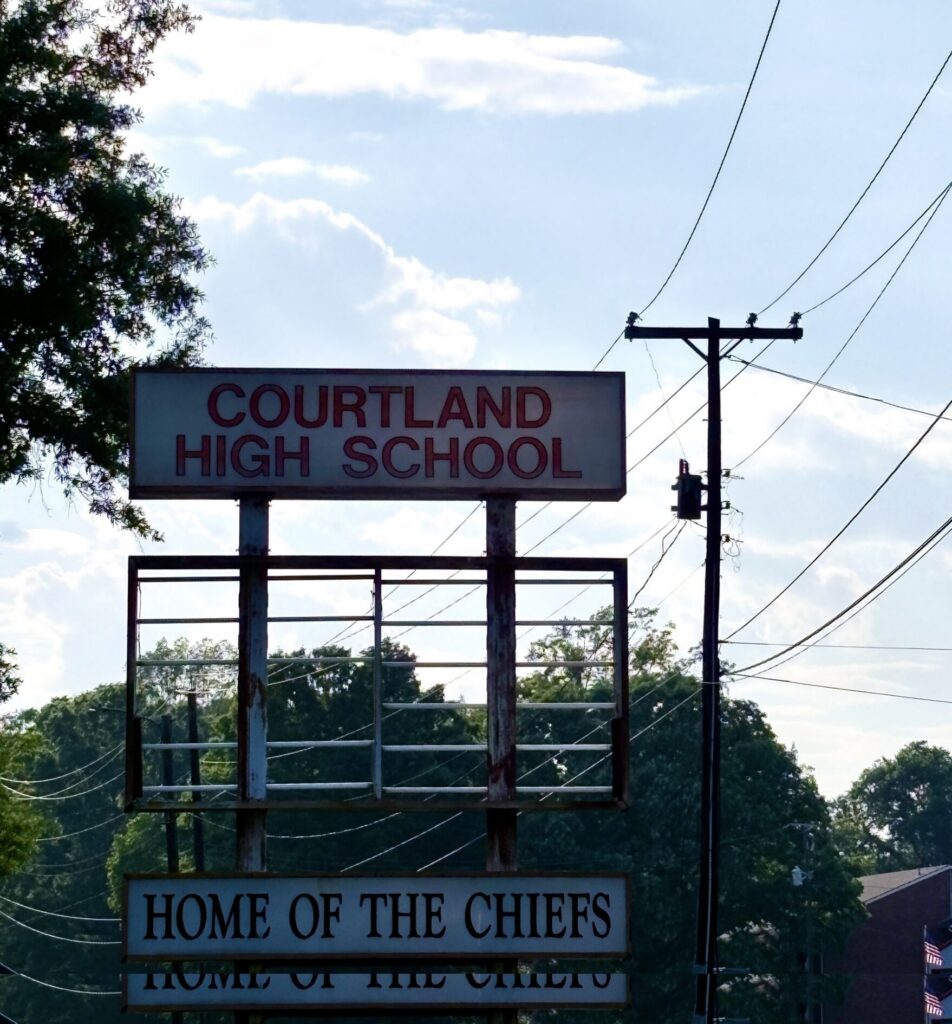
The Courtland Chiefs marching band disbanded when the school closed in 2004. A metal skeleton monument is what remains of the stands where crowds cheered on the championship football team. The occasional class reunion and a memorial scholarship serve as markers to show where the center of this town once stood.
The trains roll on
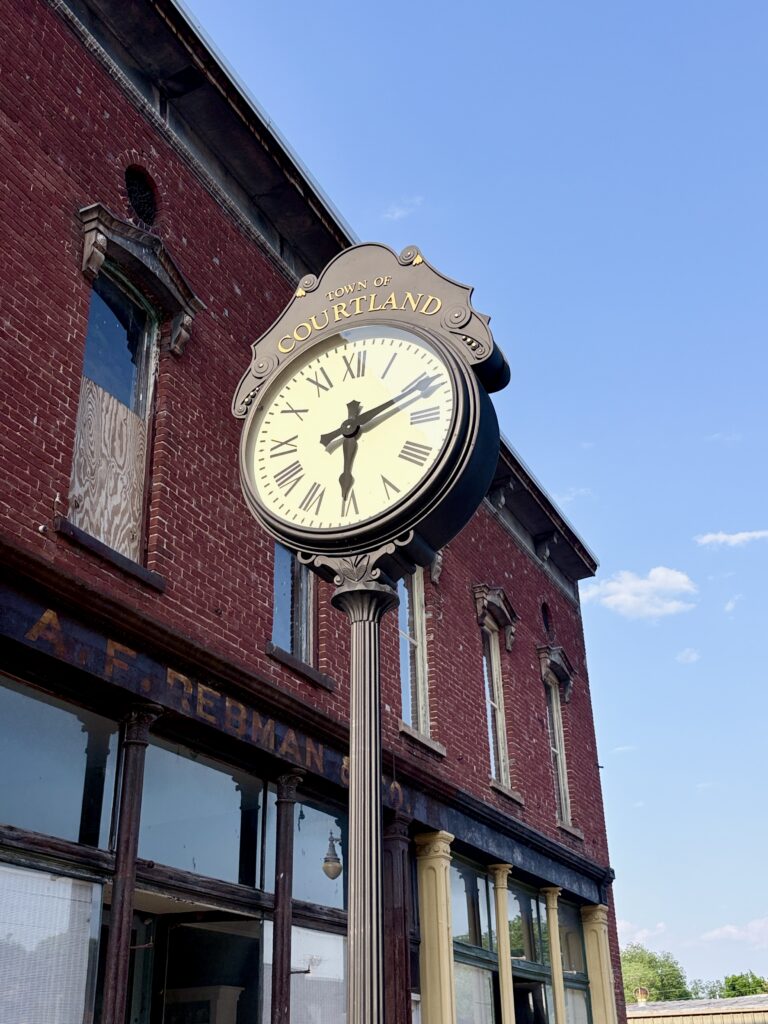
(Christy Williams/Contributed)
Just a few yards from the center of the Courtland town square, trains still whip past the old depot and water tower. A bustling cotton town thrived here during the years leading up to the Civil War. These tracks were first laid in 1832. The rails that provided an alternative route to transport cotton around the treacherous waters of the Tennessee River still carry freight past that same town square.
The Tuscumbia Courtland & Decatur Railroad was one of the first railways in the South. The railroad was mostly destroyed by the Civil War, and later rebuilt. Generations have watched trains pass while sitting in the park or from the steps of H.A. Pippen Hardware Store. Today, the storefronts look out onto the park and the trains rushing by, but shops and offices have been mostly empty for over a decade.
Incorporated in 1819, on the day before Alabama became the 22nd state admitted to the Union, Courtland’s history begins just as America’s began.
Once a Native American settlement near the Tennessee River, Courtland became a “cotton kingdom” built by enslaved men and women, Virginia and Carolina planters, and German immigrants. Today, the legacy of these founders remains standing and buried within a few blocks of the red brick walls that outline the original town square. Many of Courtland’s prominent homes and buildings were spared from the destruction of the Civil War era.
Listed on the United States’ National Register of Historic Places, Courtland boasts over 100 significant historic structures, including approximately 20 structures that predate the Civil War. The remaining historic residences are concentrated around the town square, and are in various states of repair.
Looking homeward
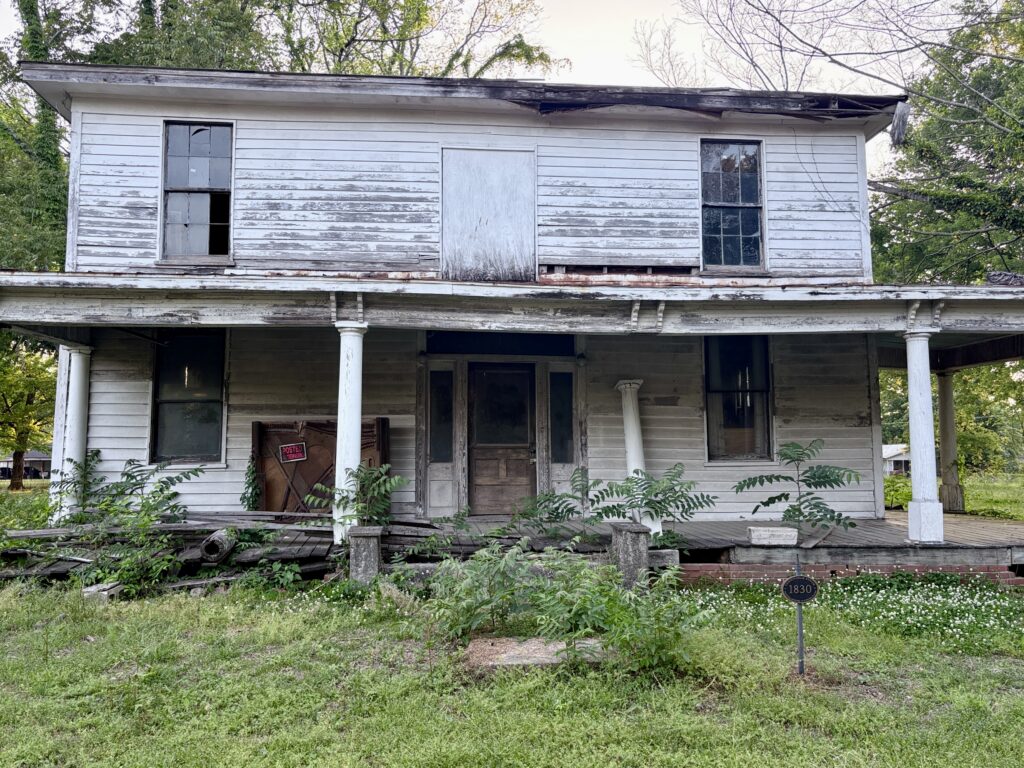
The Cunningham-Bynum House (Christy Williams/Contributed)
The Cunningham-Bynum home ca. 1830 is one of those residences. One of the most architecturally significant homes in Alabama, it features a rare hall and chamber floorplan. In 2003, The Alabama Historic Commission added it to the list of Places in Peril. The front columns are scattered, and a baby grand piano is presently parked on the crumbling porch under a ribbon of haint blue clinging to the clapboard ceiling.
Twenty-odd years after making the list, the home has new owners. Courtland transplants Jake Reed and Chris Burbank purchased the Cunningham-Bynum house in 2025 and plan a slow restoration, beginning with a new roof install slated for this summer.
Reed and Burbank first moved to Courtland in 2021 to be near family and enjoy the quiet beauty of a close-knit community. They settled into the historic Campbell-Gilchrist home, and began renovating the clapboard structure that had been built around an original dog trot cabin.
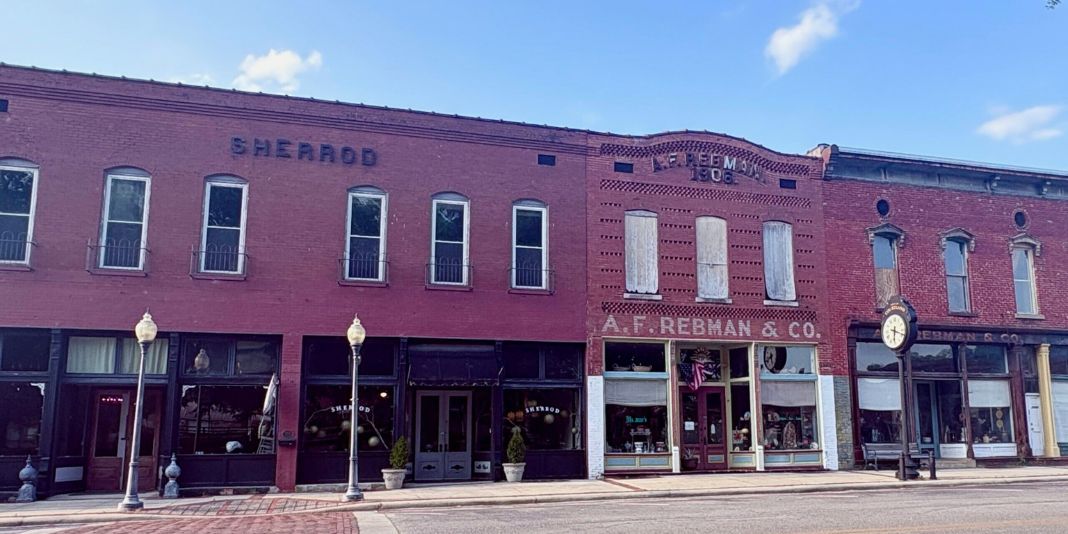
By spring of 2025, they had acquired another Courtland landmark known as the “house a dog built” and the ca. 1900 Sherrod Building on the square.
Reed spent many years as executive chef at notable restaurants in North Alabama, and missed the kitchen. So, in the fall of 2025, he and Burbank hosted the first dinner in a series known as “Dinner at the Grove”. The second dinner is scheduled for June 20, 2026 at the couple’s Courtland home.
The house a dog built
Jake Reed, the chef turned real estate professional, enjoys telling the story of acquiring the “house a dog built”. The home was purchased from a close friend whose family has owned the home since it was built in the early 1900s.
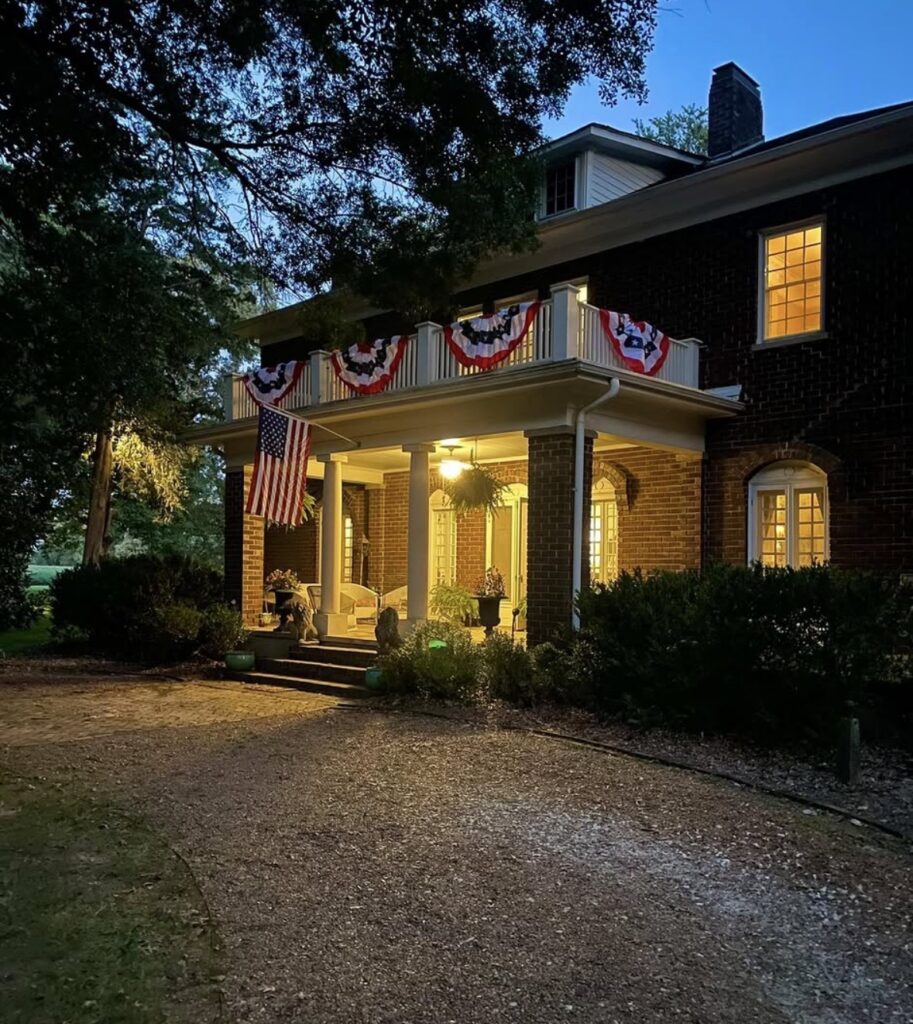
The Grove (courtesy of Jake Reed)
The home passed to the friend following the death of her father, Colonel William David Gilchrist. She was sad to let it go but needed conveniences that were hard to find in Courtland after its last grocery store closed.
She wanted to see it in the capable hands of Reed and Burbank, because of their deep love of history and experience restoring old structures. So she asked her friends, and they could not let the opportunity pass.
How did a dog build a house? Colonel Gilchrist’s cousin and namesake W.D. Gilchrist was nationally recognized in the field trial world. He raised and trained numerous hunting dogs, including a liver pointer named Lewis C. Morris, whose field trial winnings and stud fees funded the construction of the stately red brick home. Muscle Shoals Jake, a reported descendant of Lewis C. Morris, was an inaugural inductee into the Field Trial Hall of Fame.
Although the home was known as the house a dog built, W.D. Gilchrist’s mother, Louise, called it by another name. A native of Mississippi, she christened it “the Grove” in honor of Ole Miss’s famous shady spot. If you ask anyone in Courtland today, they’ll tell you it’s the Grove.
Down the street from the Grove’s massive oak trees sits the Courtland Presbyterian Church, where Jake Reed and and the former owner of the Grove became friends.
A magnolia spire stretches to the sky, and matches the height of the church’s steeple. The church was established in 1821, survived the Civil War and a fire in the 1950s, and still houses an active congregation today. The church is included on the North Alabama Hallelujah Trail, a program sponsored by the Alabama Mountain Lakes Tourist Association.
The weight of what remains
Around the corner from Courtland Presbyterian, two homes sit like sentries on either side of VanBuren street. On the left, the Garth-Shackleford House, to the right, the home known as “the Cedars”. At the end of this street rests two hundred years of lived lives, laid to rest. The Courtland Cemetery alone is worth the detour into town.
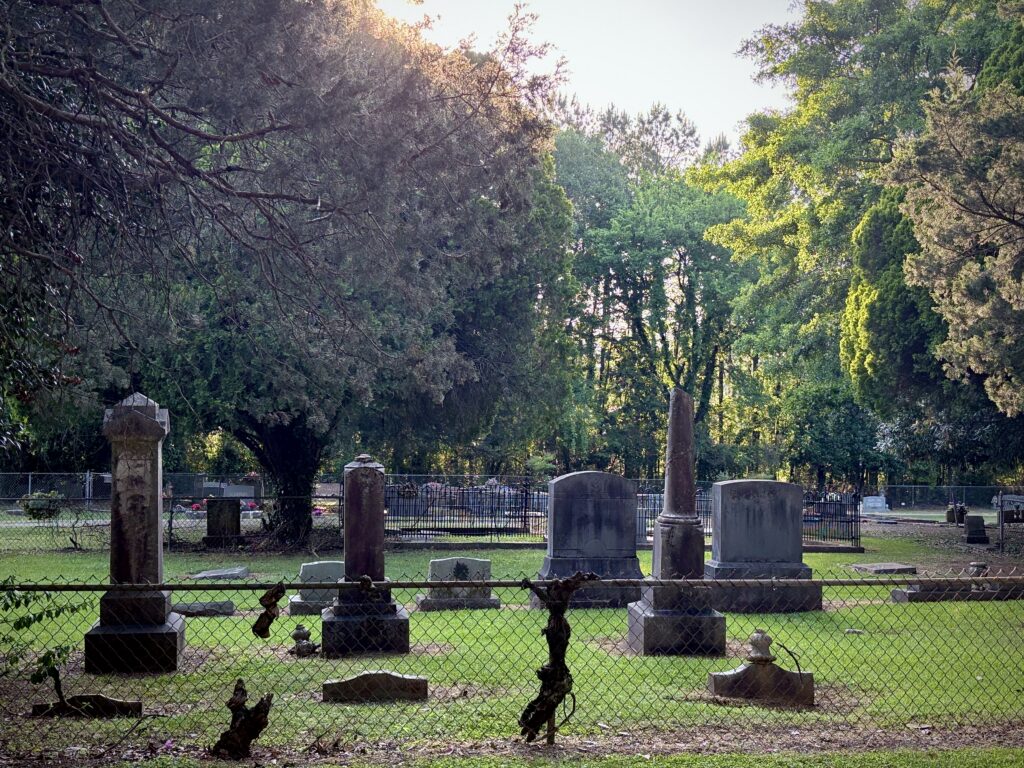
(Christy Williams/Contributed)
Interred beneath ancient cedars are Revolutionary War soldiers, town founders, Civil War soldiers, and too many Terrys to count. Lawrence County is famous for its Terry family proliferation; a family that had its own club. The Terry Club was a must-visit for campaigning politicians during the 1980s, and selling the famous chicken stew became a popular political fundraiser.
Walled off from the Terrys and other graves, there are at least two Union soldiers buried in the cemetery who died in a nearby skirmish. After the war, townspeople reportedly built a wall to divide these Northern soldiers from their world, even to the grave.
The scattered stones marking the graves range from simple pauper’s markers to soaring Victorian obelisks. The names Gilchrist, Shackleford, Martin and Cunningham cover several elaborate headstones, and often a family collection of graves is bounded by a heavy, lichen-covered wrought iron fence.
One such family plot tells the tragic story of the Pippen children. Four stone Victorian angels mark the sites where the Pippen family laid to rest their children, all of whom died before reaching the age of seven.
An Alabama Historical Commission plaque marks the entry of Courtland Cemetery. The front of the marker reads, “one of Alabama’s oldest and most picturesque town cemeteries, this site was set aside as a burying ground by the Courtland Land Company in its original survey made prior to the incorporation of the town in 1819.”
Beyond the marker lie hundreds of tombs and graves, toppled headstones, and engraved names worn illegible by time. There are many graves left unmarked. On the back of the marker, it is written, “Older graves lie mostly in the southern part of the cemetery. After the Civil War, an African-American burial ground was established just east of the main cemetery. Oldest marked graves in this section date from the early 1900s.”
Exceptional separation
R.A. Hubbard, perhaps the most notable member of Courtland’s African American community, was an educator, professor, and coach who organized one of the first schools for black children in the Courtland area.
Hubbard’s lifelong dedication to education began by working as a janitor at Old Baptist Academy in Courtland. After attending North Alabama Baptist Academy, he earned a bachelor’s degree and a master’s degree from Alabama State University. After graduation, he returned to the academy as a teacher.
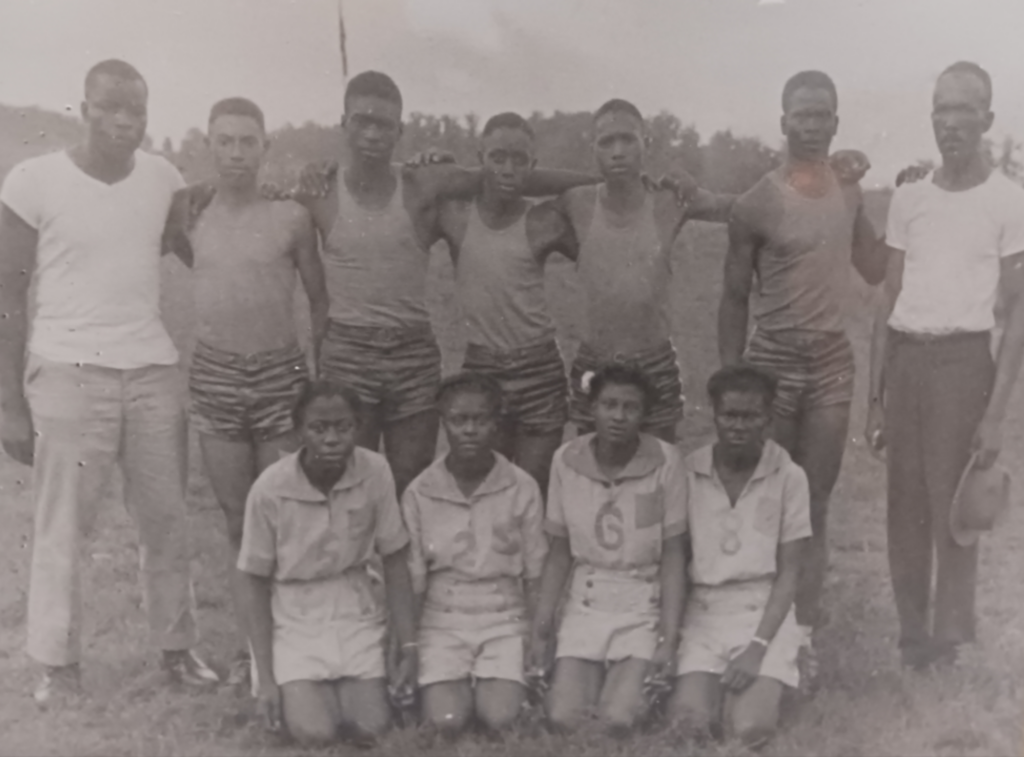
R.A. Hubbard with boys’ and girls’ teams (courtesy of Felicia White)
Hubbard founded Courtland Colored High School in 1936, later renamed Central High School. He served as principal from 1936-1971. The school was founded after Hubbard raised $750 to purchase land, and old barracks from the Courtland Airbase were donated to use as school rooms.
During Hubbard’s tenure at Central, he taught, coached and mentored several young men who would follow his example and become educators and community leaders. Brothers Hoover White, Louis White, and Mylun White were three of those young men. The children of sharecroppers, all three brothers were educated at Courtland Colored High School (later Central High School) and never imagined pursuing an education beyond Courtland.
Hoover’s daughter, Felicia White, says Mr. Hubbard was the driving force behind all three brothers earning college degrees and returning to serve their community as educators, championship coaches, and community leaders.
Hoover White coached the Central Courtland Panthers for fifteen years and was named Coach of the Year in 1960 by the Alabama Interscholastic Athletic Association. He earned seven conference titles before the AIAA merged with the Alabama High School Athletic Association in 1968 pursuant to federal desegregation orders.
Felicia is proud of her father’s seven conference championships and acknowledges the sacrifices he made traveling many miles with his team to play other schools in the conference. After desegregation, and after the state championships began rolling in, Felicia recalls that her father always accepted the awards and accolades on behalf of his players who had not had the opportunity to compete for state championships.
Little brother Louis White would have the opportunity to compete for state championships. As Head Coach at Courtland High School, he won them like few other coaches in the history of Alabama high school football.
While big brother Hoover served as principal, Coach White led the Courtland Chiefs to four football state championships and five state track championships. He was named Coach of the Year by the Alabama Sports Writers in 1985, 1988, 1989, 1990, and 1995 and awarded the Alabama Football Coaches Association Lifetime Achievement Award in 2014.
There are no more Friday night football games in Courtland, and the R.A. Hubbard High School closed in 2022 following another round of school consolidation. International Paper Mill, the town’s primary employer and source of local tax revenue, shuttered in 2014. The loss of schools and jobs ushered in a long period of silence, a shrinking population, and the last few businesses located on the square closing one by one.
Future tense
Time has passed slowly in Courtland over the last decade. In 1994, Lockheed Martin opened a facility on a 660 acre campus in Courtland, located on the same WWII era Army Air training base where R.A. Hubbard procured his first school house.
After years of starts and stops, the defense contractor built a hypersonic missile assembly facility in 2021. An 88,000-square-foot expansion was completed in 2025. New hires there are trained to assemble next-generation missile defense systems.
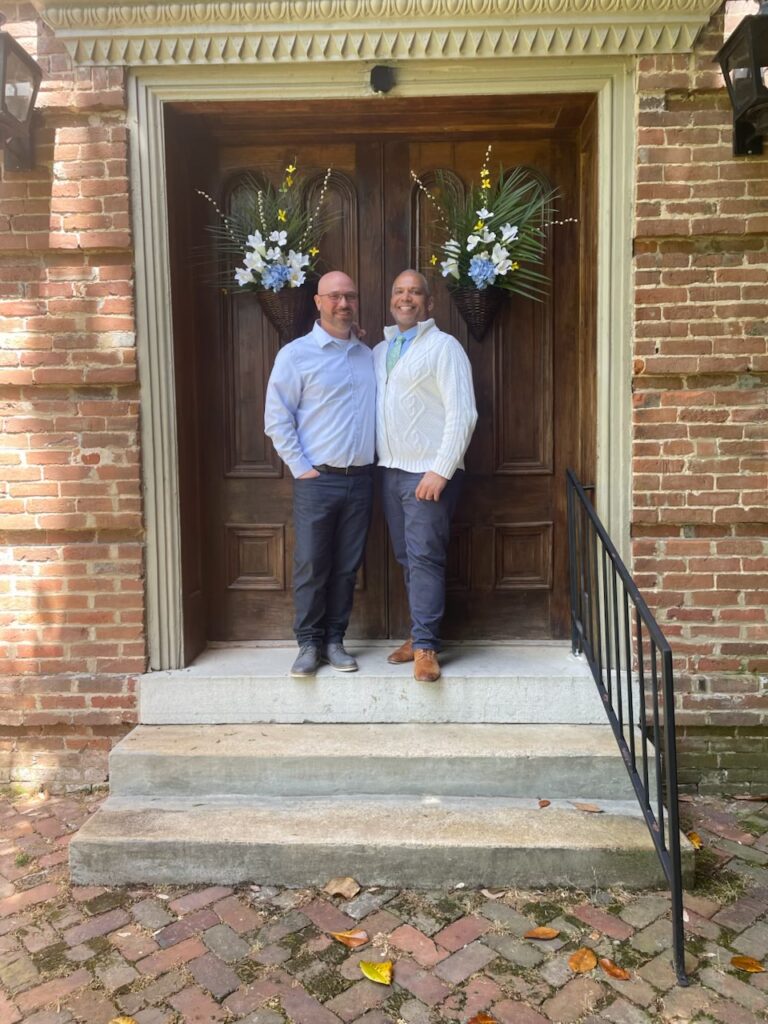
(Jake Reed and Chris Burbank/Contributed)
With defense industry employees headed to Courtland, and a renewed effort to spur tourism underway, Jake Reed believes his investment in the town and reverence for Courtland’s history will contribute to its growth.
Chris Burbank will open a new bakery and cafe in the Campbell-Gilchrist residence this summer. Sweet Magnolia Bakery & Cafe will occupy one side of the dog trot, while the other side will house a book shop. Courtland resident Melia Burkett will operate the bookstore.
After opening the bakery this summer, the couple will begin work in earnest on the next project. Currently serving as a wedding venue and event space, The Sherrod will bring diners back to the square. “It’s such a great space with the old brick walls,” he says. He plans to divide the 6600-square-foot space into an upscale dining room and a casual dining area.
Jake Reed holds the keys now, and walks through the front door of the Sherrod Building. He looks through the soaring windows to the quiet witness, the park, and sees his future.
In Courtland Today
The 50th Anniversary of Courtland’s annual Picnic in the Park is Saturday, June 6th and includes the Miss Courtland Pageant and a performance by Howell Sledge, son of legendary singer Percy Sledge.
The General Joe Wheeler Home, Pond Spring, located at 12280 AL Hwy 20, Hillsboro, AL is open for tours Wednesday-Saturday 9am-4pm.
The Annual R.A. Hubbard Legacy Banquet is Saturday, May 23, 2026 6pm-10pm, 12905 Jesse Jackson Parkway, North Courtland.
The Courtland Heritage Museum, located on the town square, is open each Saturday.
The Goode-Hall House (Saunders Hall), an extraordinary example of a pre-Civil War home built in the Palladian style, located in nearby Town Creek. Not open to public tours, but the home may be viewed from the highway.
For more information: https://www.townofcourtland.
Article courtesy of SoulGrown.