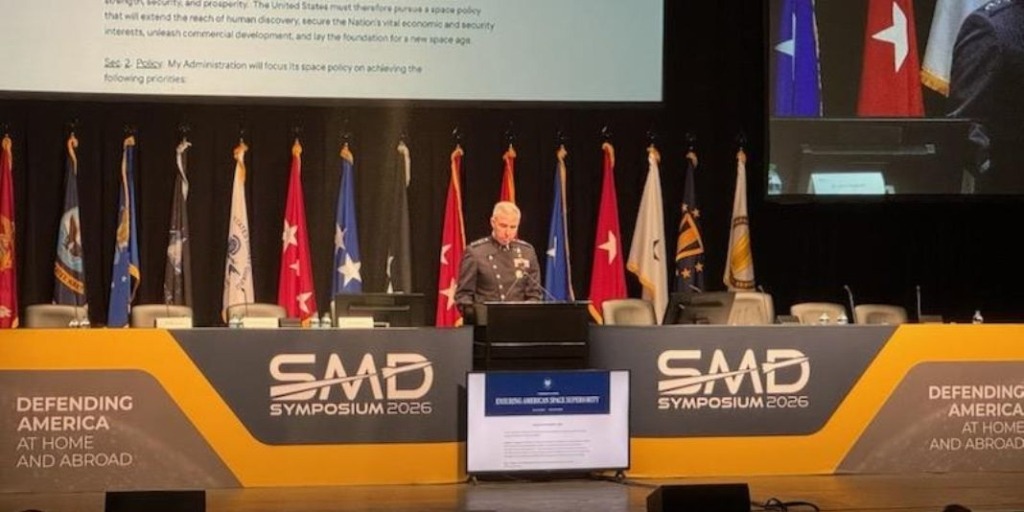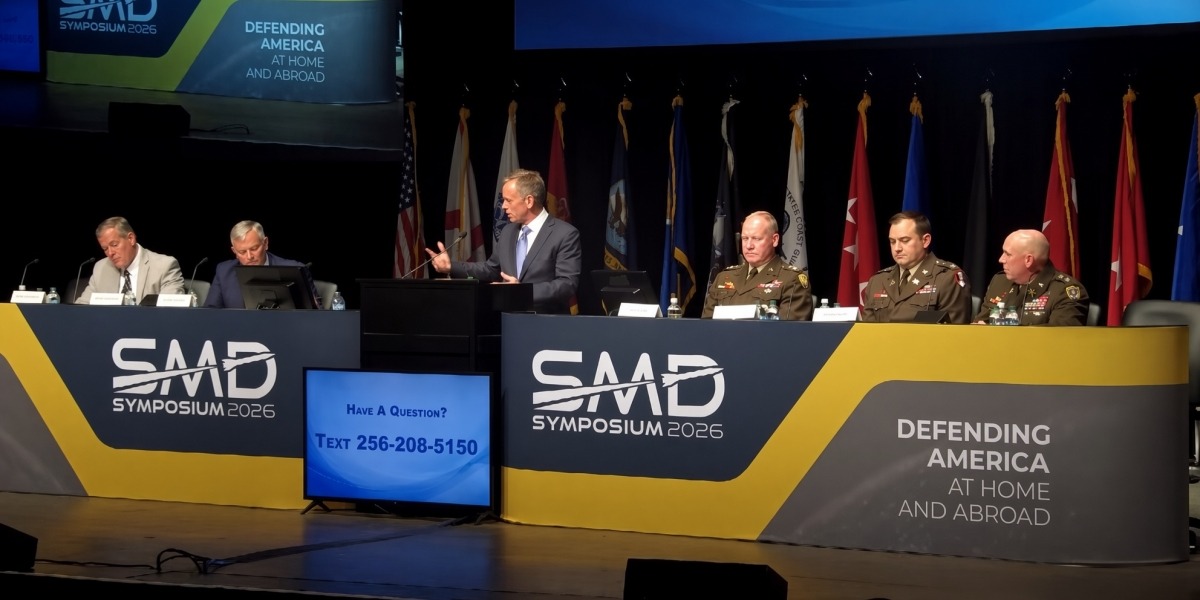
A panel of current and former military leaders at the Space and Missile Defense Symposium on Tuesday framed Golden Dome for America as more than sensors and interceptors. The discussion turned on restoring deterrence, changing how the nation plans and fights, and moving faster than traditional acquisition allows.
Golden Dome is the Trump administration’s effort to build a layered homeland air and missile defense system capable of countering ballistic, hypersonic, cruise and other aerial threats — and Huntsville sits at the center of a significant portion of that work.
Redstone Arsenal is home to both the Missile Defense Agency and the U.S. Army Space and Missile Defense Command, and a large share of the companies and units expected to deliver Golden Dome capabilities already operate in North Alabama.
Col. William “Doug” Marshall, Chief of Missile Defense, J31 Division Chief for U.S. Northern Command, was one of the first to speak on the American Golden Dome during the panel, highlighting how achievable the task would be given advancements in detection technology.
“A lot of things that were deemed at least unlikely, if not unimaginable, in the past are coming to fruition,” he said. “You can’t shoot what you can’t see.”
Other panelists echoed Marshall’s assessment, agreeing that building the system is a realistic possibility rather than a distant goal.
Retired Gen. Glen VanHerck, former commander of NORAD and USNORTHCOM, focused on preventing conflict by denying an adversary the ability to inflict damage.
“Strategic stability is eroding and the risk of deterrence failure is going up,” he said. “Golden Dome will plug that gap by creating deterrence by denial.”
Retired Gen. James Dickinson, former commander of U.S. Space Command, spoke to how urgent and relevant this moment is for the field.
“So really, you talk about relevancy, it couldn’t be more relevant now for air and missile defense and space,” he said.
Col. Tom Petrini, deputy chief of staff, G3 for U.S. Army Space and Missile Defense Command, focused on the starting point, maintaining that the Army is not starting from zero. He stated that SMDC soldiers have already executed homeland defense missions and have operated on a global battlefield over the last year.
“We’re not starting from a clean sheet of paper. Our adversaries now have the capability to target our industrial base, disrupt our power projection, and bring conflict directly to our shores,” he said. “That geographic sanctuary, the fact that America is surrounded by friendly neighbors and fish, no longer holds true.”
Lt. Gen. Brian Gibson, military deputy to the Direct Reporting Program Manager for Golden Dome for America, framed the challenge ahead differently than his fellow panelists, saying Golden Dome’s biggest obstacle isn’t technical.
“This isn’t a technical challenge. This is a culture and a structure challenge. We can’t afford to not do this. We’re moving out, and we need you on our team,” he said.
The technology is here, the will is building, and panelists made clear Huntsville is positioned to lead the way.
Zachary Austin is a writer for 256 Today. You can contact him at [email protected].