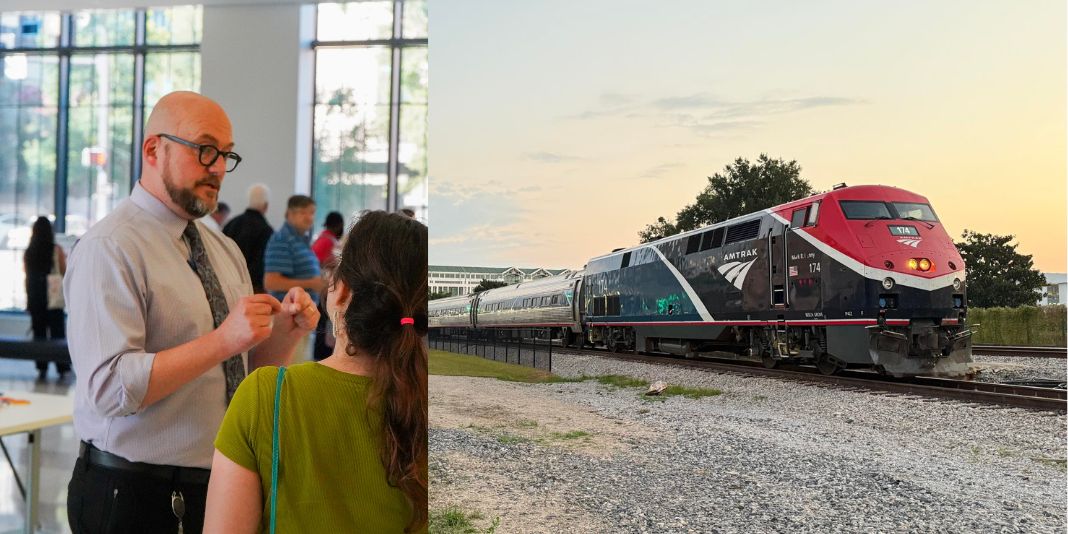
As the City of Huntsville moves forward with a newly approved intercity passenger rail study, local officials say the effort is less about immediate construction and more about positioning the region for long-term connectivity.
Dennis Madsen, manager of urban and long-range planning for the city, said the primary goal is to ensure North Alabama is included as national and regional rail plans begin to take shape.
“The biggest goal is to just make sure that as the national and regional passenger rail plans start to take shape … North Alabama is at the table as those plans are going forward,” Madsen said. “This specific effort is really about making our case.”
The study, approved by the city and funded through the Huntsville Area Metropolitan Planning Organization, will analyze travel patterns between Huntsville and major nearby metros including Birmingham, Nashville, Atlanta and Chattanooga.
Madsen said a key component will be quantifying how many people already move between those cities on a daily, weekly and monthly basis, helping determine whether passenger rail could be viable.
“So how much traffic could we potentially be capturing?” he said. “You want to be able to show potential ridership, and a lot of that too is tied to our growth as we continue to grow as a region.”
City leaders point to that growth as a driving factor. Madsen noted Huntsville alone is adding an average of 17 people per day, not including surrounding communities.
“If you wait until you need rail to plan for rail, at that point it’s too late,” he said.
While Huntsville’s study is just beginning, Madsen said other Southeastern cities are also exploring passenger rail, signaling growing regional momentum.
Earlier this year, both Birmingham and Chattanooga publicly announced plans to study connections to Atlanta. He also pointed to the recently launched “Mardi Gras” rail line linking New Orleans and Mobile, which has already surpassed 100,000 riders.
“There’s real utility there,” Madsen said. “As those kinds of segments are starting to take shape, we just want to make sure that Huntsville is at the table for that discussion.”
He compared the effort to past infrastructure decisions that shaped the region’s growth, including the placement of Huntsville International Airport.
“You want to make sure that when the interstate highway comes through, it comes through near you,” he said. “This is really thinking forward in terms of what we’re going to need in the future.”
The study will also evaluate potential rail corridors and whether they would rely on existing freight lines, new infrastructure or a combination of both.
“That’s one of the main thrusts of the study,” Madsen said. “What routes make sense?”
Any future system would require extensive coordination with freight rail operators, as well as state and federal partners, he added.
“This is the sort of scope that transcends any city’s ability to do anything,” Madsen said. “You can’t do a rail plan for Huntsville and not have Birmingham or Nashville also doing one at the same time. You’ve got to have a plug that you’re plugging into somewhere.”
The study is expected to run through 2027. After that, Madsen said the next phase would involve deeper coordination with federal agencies, neighboring cities and rail operators.
“The next step is potentially you can engage with the federal government on looking in more detail at the corridors,” he said. “You also want to make sure you’re engaging with other communities.”
He added that building a national or regional passenger rail network will ultimately require federal leadership and multi-state cooperation.
“To make national rail happen, you need the federal government at the table, you need the major carriers at the table,” Madsen said.
While the study will help define demand, Madsen said passenger rail could serve multiple purposes if implemented.
“I think hopefully it’s all of the above,” he said, referencing business travel, commuting and tourism.
He noted the potential convenience for business trips to Birmingham or state-related travel, as well as leisure options.
“Me personally, I also like the idea of a beach train,” Madsen said. “To be able to get on and not have to worry about … traffic on I-65.”
For now, city leaders emphasize the study is an early but important step in a long-term process.
“This is just another layer of infrastructure, building resiliency in terms of our transportation network,” Madsen said. “It’s going to be a while, but at least we’re headed in that direction.”