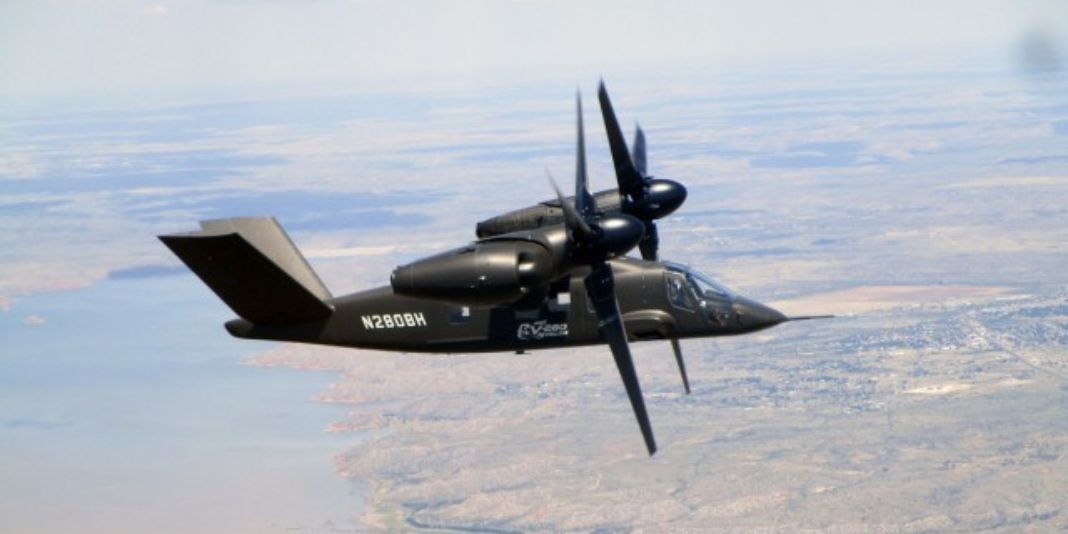
The U.S. Army has officially named its next-generation Future Long Range Assault Aircraft the MV-75 “Cheyenne II,” marking a major milestone for a program managed from Redstone Arsenal.
The announcement was made Tuesday during the Army Aviation Association of America’s annual conference, where officials also unveiled the aircraft’s mission design series designation as MV-75.
The Cheyenne II is designed to transform Army aviation, combining the vertical lift capability of a helicopter with the speed and range of a fixed-wing aircraft. Officials say the platform can fly roughly twice as far and twice as fast as the current fleet, including the UH-60 Black Hawk it is slated to replace.
“The Cheyenne people represent a resilient warrior culture and embody the key attributes of the MV-75 – speed, reach, lethality, and adaptability,” said the HON Brent Ingraham, Army Acquisition Executive. “I am honored to be part of this historic occasion as we officially name our multi-mission tiltrotor aircraft.”
While the aircraft will be manufactured by industry partners, much of the program’s development, management and future fielding is being led by the Program Executive Office Aviation, headquartered at Redstone Arsenal.
That puts Huntsville at the center of one of the Army’s most significant modernization efforts, with Redstone-based teams overseeing an accelerated timeline aimed at fielding the aircraft to operational units by the end of the decade.
“Representing the future of Army aviation, the MV-75 embodies the strength and versatility of the Cheyenne tribes,” said Maj. Gen. Clair Gill, Portfolio Acquisition Executive and commanding general at Fort Rucker, Alabama. “This aircraft will revolutionize how the Army fights and wins, delivering unmatched capabilities to the Joint Force and ensuring we maintain a decisive advantage on the battlefield.”
The naming process followed an extensive review of more than 500 Native American tribes, figures and terms. The “Cheyenne II” name also nods to the AH-56 Cheyenne, a high-speed attack helicopter developed in the 1960s that, while never fielded, left a legacy of innovation.
“This is a historic day for our MV-75 Cheyenne II team and the Army,” said Rodney Davis, Capability Program Executive, Aviation. “Stakeholders across the Army aviation enterprise were deeply involved in the research and analysis during the naming process. We are proud to honor the Cheyenne tribes and their legacy.”
At Redstone Arsenal, teams are already working on advanced elements of the program, including virtual prototyping, digital engineering and integration of next-generation technologies. The aircraft is built with a modular, open systems architecture, allowing it to evolve with new capabilities over time.
“The MV-75 is a transformational aircraft that will provide our Joint Force with unparalleled versatility to dominate a wide array of mission sets,” said Col. Jeffrey Poquette, project manager for the MV-75 Cheyenne II. “We are honored to have the Cheyenne tribes’ approval to use their name, which embodies the power of this aircraft.”
As the Army continues to modernize its aviation fleet, officials say the Cheyenne II will play a central role in expanding operational reach and ensuring U.S. forces maintain an edge in future conflicts with Huntsville and Redstone Arsenal at the heart of that effort.