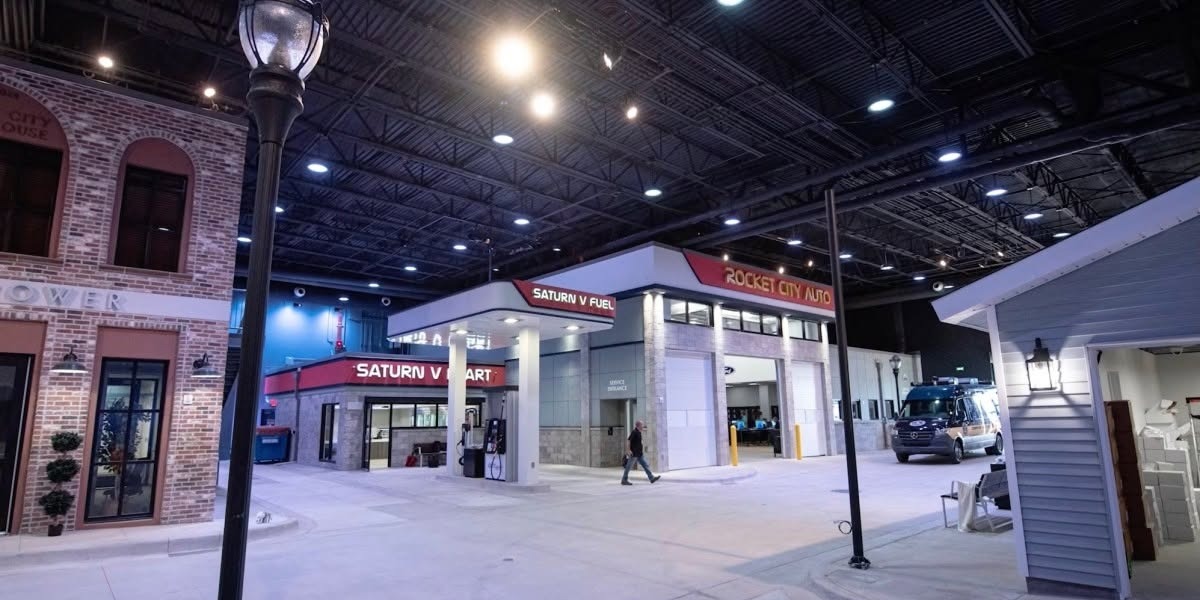
Inside the FBI’s Huntsville campus sits what appears to be a small town complete with houses, a hotel, a hospital, a gas station and convenience store, and even traffic lights. But the buildings aren’t there to house residents — they’re part of a training environment designed to prepare investigators for cybercrime and digital forensics cases.
The FBI recently provided a behind-the-scenes look at its Kinetic Cyber Range, a 22,000-square-foot training environment at the bureau’s North Campus on Redstone Arsenal.
Since opening in February 2025, the facility has trained more than 1,400 students, including FBI personnel and partners from other agencies.The training comes as cybercrime continues to pose growing challenges for businesses, government agencies, and individuals.
According to the FBI’s 2025 Internet Crime Report, Americans reported $20.9 billion in cybercrime losses during 2025, a 26% increase from the previous year. The report also identified ransomware as one of the most significant threats facing critical infrastructure.
The range reflects the FBI’s effort to move cyber and digital forensics training beyond the classroom and into scenarios that mirror real-world investigations.
“In the past, you never left the classroom,” said Dave Beachboard, who manages the Kinetic Cyber Range. “Everything was presented to you at your desk. You would process a cell phone or a piece of loose media, learn about servers. Everything was kind of theory-based, along with a little bit of hands-on.”
The facility includes houses, hotel rooms, a hospital, a power company and a gas station, all equipped with functioning systems, networks and devices designed to operate as they would in real life.
The homes, businesses and public facilities are fully furnished and equipped with functioning technology designed to mirror the settings investigators may encounter during actual cases.
But officials say realism goes beyond the buildings themselves.
“The systems that we have running in these facilities are just as real as the facade on the outside,” Beachboard said. “When they start diving into the network, they’re going to see Active Directory, email, firewalls—everything that’s typical of that venue.”
Students are placed in a variety of scenarios. In one exercise, they move through a home filled with internet-connected devices and determine what should be collected as evidence. In another, they serve a search warrant at a business and work with system administrators to access information stored within a corporate network.
The range also includes a data center with more than 200 servers running two different operating systems.
“I have a data center that has over 200 servers running in it,” Beachboard said. “Some are running Windows, some are running Linux. So, a student gets to encounter what it’s like working in a data center.”
The training environment is also used for vehicle-forensics exercises. During one recent course, students were required to physically remove a vehicle’s electronic control unit, often described as the vehicle’s digital brain, and extract potential evidence from the device.
The Kinetic Cyber Range brings together personnel from the FBI’s Operational Technology Division, which focuses on digital forensics, and the Cyber Division, which investigates computer intrusions and cybercrime.
“The success of our investigations and operations require the various job roles that make up a cyber squad working together,” said Stephanie Cassioppi, who leads the unit responsible for cyber training in Huntsville.
For cyber investigators, she said, the challenge often involves tracking activity across networks rather than collecting physical evidence.
“For us, our threat actors are overseas,” Cassioppi said. “The odds are I’m never going to get my hands on their computer or their phone.”
To recreate those challenges, the FBI uses role players acting as business owners, executives and legal representatives. Students must conduct interviews, explain investigative procedures and communicate what information is and is not being collected, giving trainees experience handling the people side of cyber investigations in addition to the technical work.
“Interviews are conducted ensuring the company understands what we are collecting, but, more importantly, what we are not collecting,” Cassioppi said.
Some scenarios raise the stakes even further. In one exercise, a simulated ransomware attack shuts down a hospital network while role players respond as though patient care is at risk. Investigators must navigate both the technical response and the human consequences of the incident.
The goal, officials said, is not only to build technical expertise but also to prepare investigators to make decisions under pressure.
“Cyber is not just technical,” Cassioppi said. “It’s also practicing those soft skills, the dealing with people.”
The FBI says the training environment also gives students an opportunity to make mistakes before they encounter similar situations in actual investigations.
“We try to keep the scenarios as real as possible,” Beachboard said. “Everything’s based off of past case studies.”
“We want them to make the mistakes in the Kinetic Cyber Range,” Cassioppi added. “That’s when we can slap their hands and kind of say, ‘Hey, this is a learning opportunity. This is what you don’t want to do when you get out into the real world.’”
As technology evolves, officials said the training evolves with it. Scenarios are regularly updated to incorporate emerging threats, connected devices, drones, vehicle forensics tools and other technologies that investigators are likely to encounter.
“If we see gaps in training, we will adjust,” Beachboard said, “making sure that students are encountering the latest software, the latest Internet of Things, the latest drones, the latest vehicle forensics—all of that to keep us cutting edge.”
Sherri Blevins is a reporter for 256 Today.
Got a tip for OTR? Send your tip to [email protected] with related photo/video, your name, phone number, and e-mail address.