Deer hunters in three northwest Alabama counties will face mandatory Chronic Wasting Disease testing on select weekends during the upcoming season as wildlife officials continue efforts to contain a disease that is always fatal to infected deer.
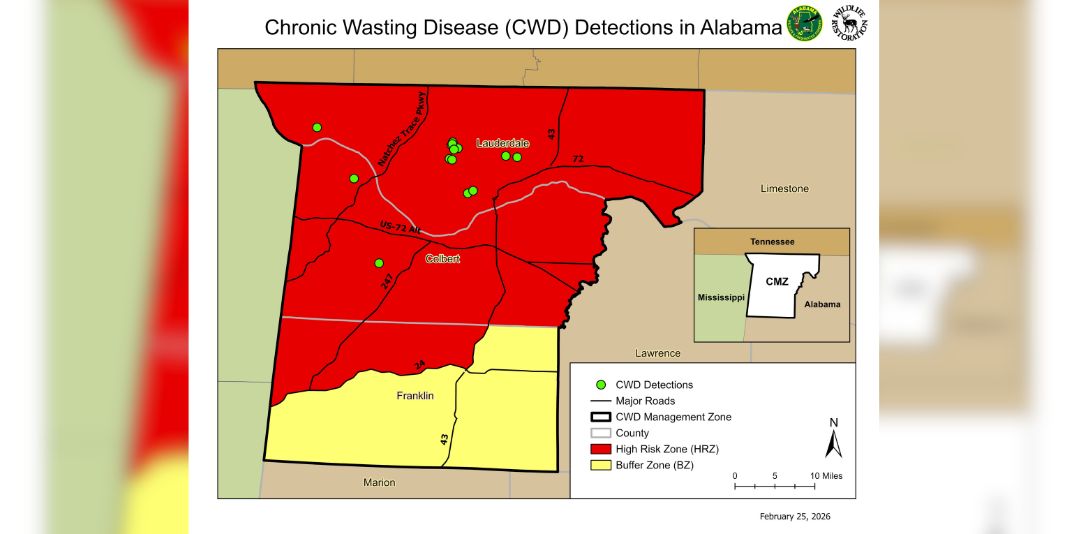
The Alabama Department of Conservation and Natural Resources announced the testing dates for the state’s Chronic Wasting Disease Management Zone, which covers Lauderdale, Colbert and Franklin counties.
Alabama’s first confirmed case of CWD was detected in a hunter-harvested white-tailed deer in Lauderdale County in January 2022. The discovery prompted the state to establish special hunting, testing and carcass transportation rules intended to monitor the disease and reduce the risk of spreading it to other areas.
What hunters need to know
The management zone is divided into two areas based on risk.
The High-Risk Zone includes all of Lauderdale and Colbert counties and the portion of Franklin County north of Alabama 24 from the Mississippi state line east to U.S. 43.
Hunters who harvest deer there must submit them for CWD testing during three weekends:
- Nov. 21-22, the opening weekend of gun deer season
- Jan. 16-17
- Feb. 6-7
The Buffer Zone covers the remaining portion of Franklin County south of Alabama 24 and east of U.S. 43. Mandatory testing there will be Jan. 16-17 and Feb. 6-7.
ADCNR has also designated alternate testing weekends if weather or other circumstances interfere with the scheduled dates.
Testing requirements are even broader on certain public lands within the management zone. Deer harvested at Freedom Hills, Lauderdale and Seven-Mile Island wildlife management areas, the Cherokee Physically Disabled Hunting Area and Riverton Community Hunting Area must be sampled throughout the season.
What is CWD and why does it matter?
Chronic Wasting Disease is a contagious neurological disease that affects white-tailed deer and other members of the deer family. It is caused by abnormal proteins known as prions and is always fatal to infected deer.
Because infected carcasses can potentially spread the disease to areas where it has not been detected, Alabama also restricts where hunters can take deer harvested within the management zone.
Whole deer and most carcass parts taken in the High-Risk Zone cannot be transported outside that zone. Deer harvested in the Buffer Zone must remain within the larger CWD Management Zone.
There are exceptions. Completely deboned meat, cleaned skull plates and antlers without visible brain or spinal cord tissue, and raw hides without those tissues can be taken outside the zones.
The management zone also prohibits baiting and supplemental feeding of wildlife, with limited exceptions including normal agricultural and food plot practices and certain residential bird and squirrel feeders.
Extra buck permits offered for testing
ADCNR is also offering hunters an incentive to provide samples on mandatory testing dates.
Hunters who harvest a deer within the management zone and submit it for CWD testing on those dates can receive a CWD Sampling Permit allowing them to harvest one additional antlered deer within the zone.
Hunters can receive no more than two of the additional permits above the normal season bag limit. The permits are available only at wildlife management area check stations and ADCNR mobile sampling locations and cannot be transferred to another hunter.
Outside the mandatory dates, hunters throughout the management zone are encouraged to voluntarily submit deer for testing at self-service sampling freezers. Hunters elsewhere in Alabama are also encouraged to participate in voluntary testing.
Sampling locations and a map of the management zone are available through Outdoor Alabama’s CWD information page.
Got a tip for OTR? Send your tip to [email protected] with related photo/video, your name, phone number, and e-mail address.