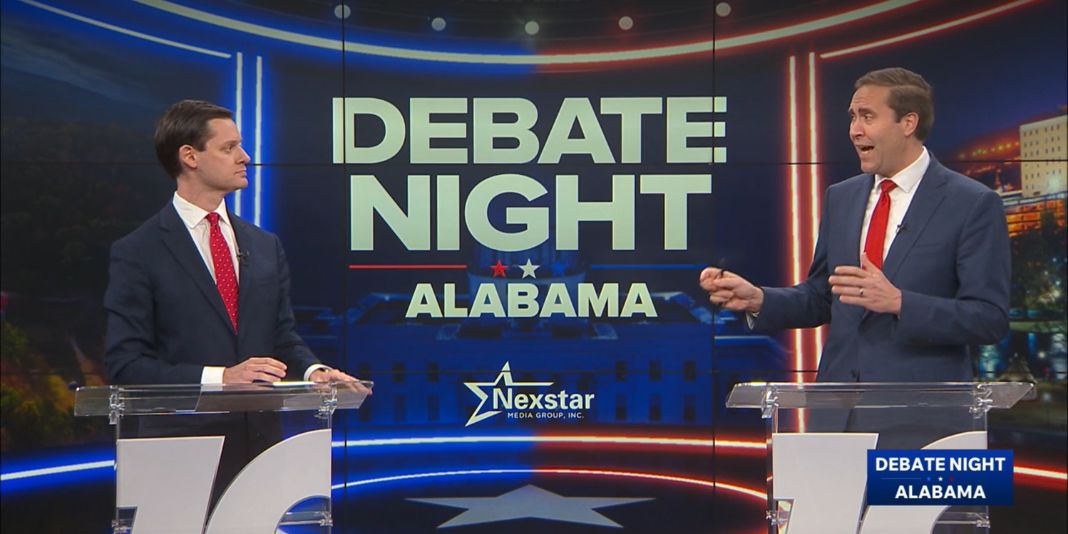
Republican John Wahl and Democrat Phillip Ensler traded sharp accusations over residency, campaign contributions and political records Wednesday night during a statewide lieutenant governor debate that also featured substantive exchanges on taxes, healthcare, education and public safety.
The hourlong debate, broadcast statewide by WHNT News 19 and Nexstar Media Group from News 19’s downtown Huntsville studios, gave voters a rare opportunity to hear the candidates challenge each other directly ahead of Tuesday’s general election.
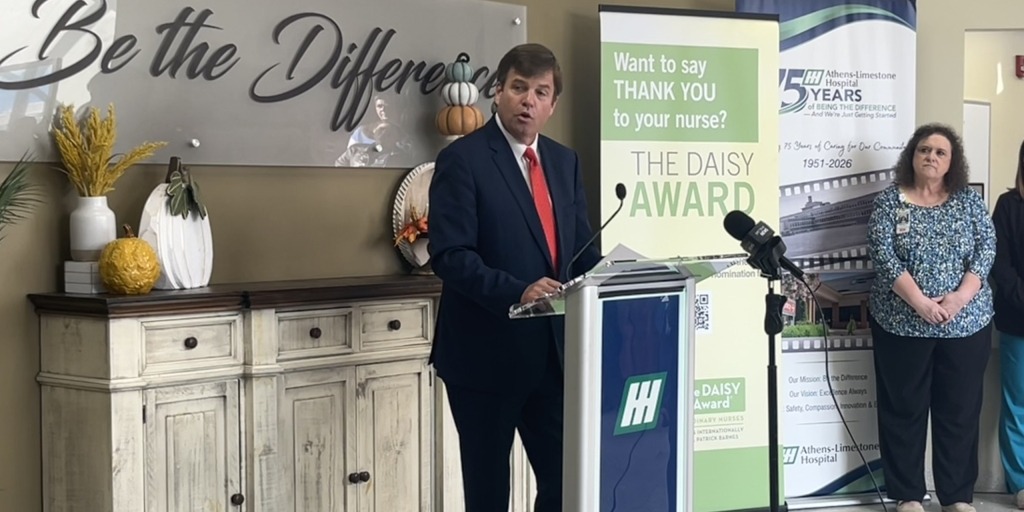
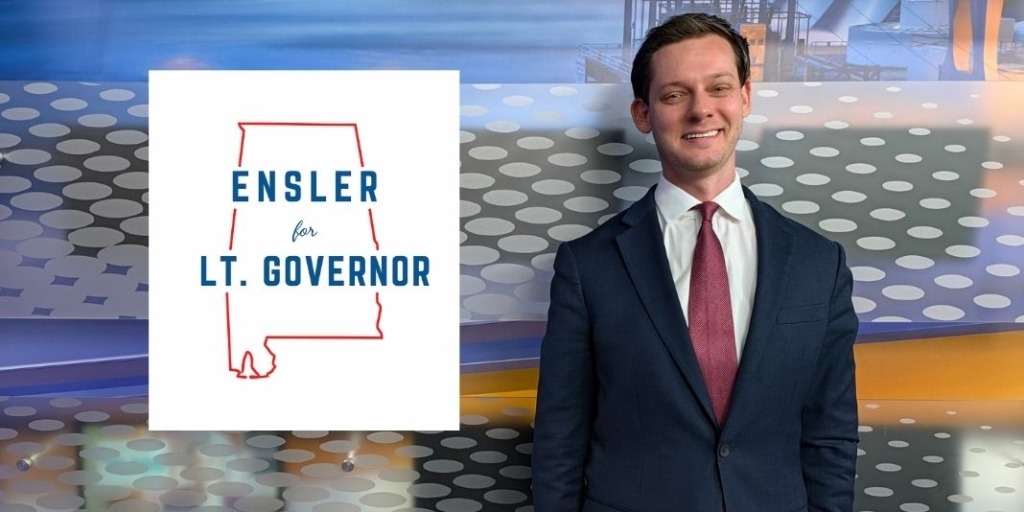
Wahl, a Limestone County resident and former chairman of the Alabama Republican Party, is making his first bid for statewide office after winning a crowded Republican primary. Ensler, an attorney and former public school teacher, has represented the Montgomery area in the Alabama House of Representatives since 2022.
News 19 anchor Tamika Alexander hosted the debate, with anchors Greg Screws and Kayla Smith moderating. Questions developed by the station’s political team and submitted by viewers covered issues ranging from Alabama’s grocery tax to the growing controversy over data centers.
The candidates found some common ground on reducing taxes, protecting rural hospitals and addressing prison overcrowding. But the evening’s most heated exchanges came when they questioned each other’s political backgrounds and judgment.
Residency accusations spark heated exchange
One of the night’s sharpest confrontations centered on Wahl’s eligibility to serve as lieutenant governor.
Smith questioned Wahl about challenges to his Alabama residency, noting he had prevailed in proceedings within the Republican Party and in court despite having a second residence and voter registration in Tennessee.
Wahl, a Limestone County resident and former Alabama Republican Party chairman, argued that the Alabama Constitution requires maintaining a residence in the state for seven years, not exclusively residing there.
“The fact that you may have a second residence does not mean you abandoned your original residence,” Wahl said.
He maintained that he had consistently remained an Alabama resident, voted in Alabama and paid taxes in the state.
Ensler challenged that explanation, accusing Wahl of having sworn under oath that he was a Tennessee resident and questioning his Alabama voting credentials.
“You either committed perjury or voter fraud,” Ensler alleged.
Wahl countered with accusations about Ensler’s own voting history, claiming the Montgomery-area legislator continued voting in New York after moving to Alabama.
Ensler rejected the accusation.
“That is an outright lie,” Ensler said.
Wahl maintained that voting records would support his claims and offered to provide them to the press.
Neither candidate’s allegations against the other were independently established during the debate.
Campaign donation dispute turns personal
Another contentious exchange followed a question about gun rights and domestic violence.
Ensler criticized Wahl for retaining campaign contributions from Christopher Drummond, whom Ensler described as a donor facing domestic violence charges.
Wahl responded that he was friends with both Drummond and his wife and said the contributions were made while the couple was together.
“The situation going on with them is a tragedy,” Wahl said.
Ensler interrupted, arguing that the alleged violence was a tragedy for the woman, not the accused man.
Wahl said the matter should be handled through the legal system rather than used for political gain.
“No one’s domestic dispute and no one’s domestic problems should be brought into a debate statewide for political gain,” Wahl said.
The exchange became one of several moments when moderators had to move the candidates back to the scheduled questions.
Grocery tax draws agreement, disagreement over credit
Both candidates supported eliminating Alabama’s remaining state sales tax on groceries, but disagreed sharply over which party deserved credit for previous reductions.
Wahl pointed to tax cuts enacted under Republican leadership and said eliminating the remaining grocery tax would be an immediate priority.
Ensler argued Democrats had introduced grocery tax legislation for years and accused Republicans of moving too slowly despite controlling state government.
The candidates also differed on how to replace lost revenue.
Ensler advocated establishing a state lottery, saying proceeds could support education, rural hospitals and other priorities.
Wahl expressed moral concerns about a lottery but said voters should have an opportunity to weigh in. If one were approved, he said he would prefer directing revenue toward tax relief.
Data centers and rural hospitals
The candidates expressed similar concerns about large data centers, particularly their effects on utility rates and surrounding communities.
Wahl said data centers could bring investment but should be required to protect residents from higher electricity costs and excessive water use.
“We want the capital investment. We need data centers, but we need to do it the right way,” Wahl said.
Ensler reiterated his call for a moratorium on new data center construction until Alabama establishes a more transparent review process.
Both also acknowledged the crisis facing rural hospitals and the difficulty of reopening facilities after they close.
Ensler advocated expanding Medicaid, arguing it would provide a financial lifeline for struggling hospitals and improve access to maternal healthcare.
Wahl emphasized keeping existing hospitals open and exploring partnerships with local medical providers, nonprofits and other facilities to improve emergency access.
The discussion grew pointed when Wahl suggested using healthcare professionals associated with nursing homes as part of broader local healthcare solutions. Ensler questioned how nursing homes could address emergency medical needs, while Wahl said his proposal focused on finding ways to use existing doctors and nurses.
North Alabama investments and education
The moderators also raised major federal investments in North Alabama, including Space Command and the FBI’s expanding presence at Redstone Arsenal.
Asked what a Democratic lieutenant governor could contribute amid those investments, Ensler said he would work with Alabama’s congressional delegation regardless of party to continue bringing federal resources to the state.
Wahl, who grew up in Limestone County, pointed to North Alabama’s economic success as a model for other parts of Alabama.
“We’ve seen that in North Alabama,” Wahl said. “You know, I’m from North Alabama and it’s the economic engine of the state. And I want to bring that same success to the rest of Alabama.”
On education, Wahl championed Alabama’s CHOOSE Act and school choice, arguing parents should control educational decisions.
Ensler, a former public school teacher, said public funding should prioritize public schools. He acknowledged the CHOOSE Act would likely remain in place but advocated income limits to better target assistance toward families needing it most.
The candidates also disagreed about whether political and social ideologies are being introduced into Alabama classrooms. Wahl said inappropriate material was a significant concern among teachers and parents, while Ensler disputed that it was widespread.
Finding common ground on prisons
Both candidates agreed Alabama’s prison system needs reform and that construction costs have become excessive.
Ensler called for stronger rehabilitation and reentry programs, improvements to the parole process for eligible nonviolent offenders and better access to mental healthcare.
Wahl emphasized accountability for prison construction projects and supported vocational training and rehabilitation opportunities to help eligible inmates return to society.
Ensler acknowledged their agreement on costs.
“I think you make a great point about that,” Ensler said. “The price has gone well beyond what it should be.”
Candidates make final appeal
During a segment allowing each candidate to question the other, Wahl asked whether Ensler would support eventually eliminating Alabama’s income tax.
Ensler said he supported income tax reductions for working- and middle-class families but opposed eliminating the tax entirely because of potential effects on public services.
Ensler asked Wahl to identify an issue on which he agreed with Democrats. Wahl pointed to civil rights and religious liberty, although the exchange soon returned to disagreements over Alabama’s political history and voting rights.
In their closing appeals, Ensler emphasized his legislative experience and willingness to challenge special interests, while Wahl focused on constitutional freedoms, parental rights, school choice and smaller government.
A commercial interruption during the online stream obscured the majority of Ensler’s closing statement.
The debate concluded with both candidates urging voters to participate in the Nov. 3 general election.
Got a tip for OTR? Send your tip to [email protected] with related photo/video, your name, phone number, and e-mail address.