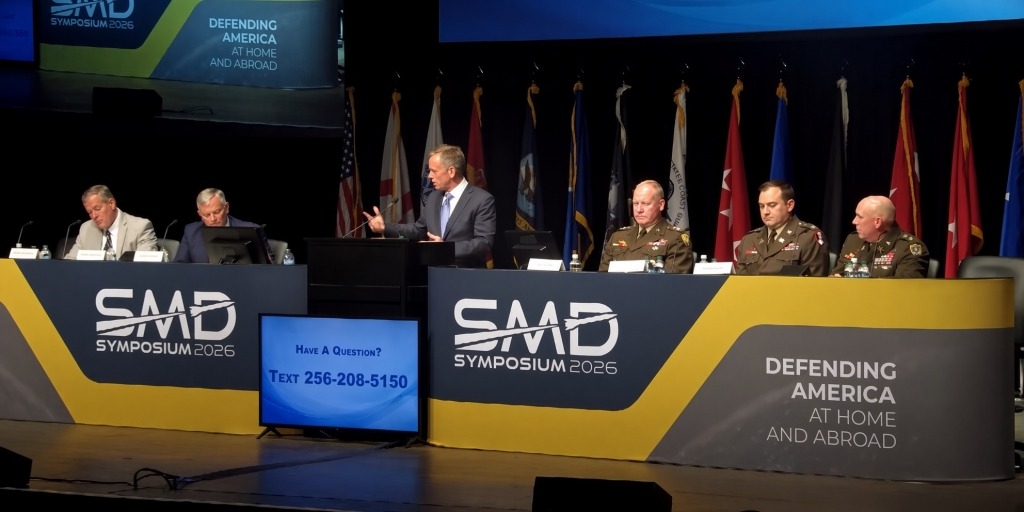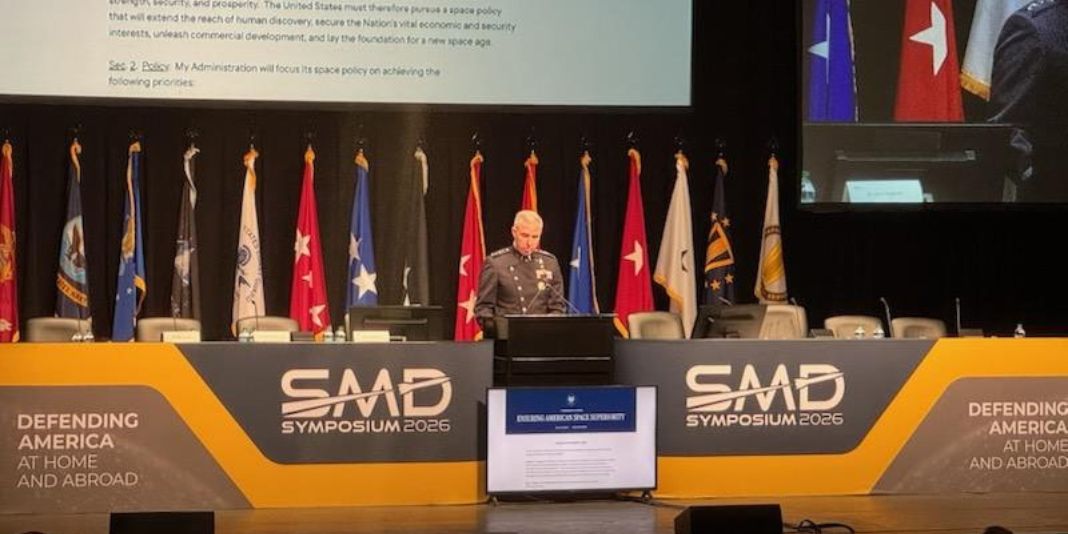
U.S. Space Command Commander Gen. Stephen Whiting used one of the most anticipated addresses of the 2026 Space and Missile Defense Symposium Wednesday morning to deliver two messages with particular significance for Huntsville: the threat is accelerating, and U.S. Space Command is wasting no time establishing its new home at Redstone Arsenal.
Speaking to a packed Concert Hall at the Von Braun Center, Whiting said the command now has 113 personnel working at Redstone and remains on track to have 200 in Huntsville by the end of the year.
“We’re moving out at full speed to make the Rocket City and Redstone Arsenal our new home,” Whiting said.
The command opened its first operational facility at Redstone in April. Whiting said more than half of the headquarters staff is expected to be working at the Arsenal by the end of 2028, with the entire command fully moved by 2032.
“This place also feels a little more like home every time I visit, because U.S. Space Command is making it our new home bit by bit,” Whiting said.
The relocation is ultimately expected to bring roughly 1,800 Space Command employees to Huntsville once the permanent headquarters at Redstone Arsenal is complete, and Whiting made clear Wednesday that contractors supporting the command should also be planning for the transition.
“If you are already a contractor supporting U.S. Space Command, we need you to be working with us with your contracting officer on how do you begin to transition support here to Huntsville,” he said.
Whiting said the command will operate in both Colorado Springs and Huntsville for a period of time and will require contractor expertise in both locations as the transition unfolds.
He also issued a direct invitation to companies involved in construction and facility design as Space Command moves toward building a purpose-built command and control headquarters at Redstone.
“If you have some way you think you might be able to assist us, please see Terry or Colonel Ray Rusko or the team here at our Redstone transition team,” Whiting said. “We’d love to have that conversation with you.”
‘There is no safe harbor’
But much of Whiting’s address focused beyond the move itself and on what he described as an increasingly dangerous operational environment in space.
Whiting said the United States is no longer preparing for a hypothetical future conflict in the space domain.
“This year, there’s no hypothetical countdown,” he said. “We’re in an operational reality of ongoing operations right now.”
He said adversaries are actively probing networks, attempting to jam sensors and targeting space and missile defense assets.
“The war in Ukraine and in Iran has put a giant exclamation point on something we’ve known for some time,” Whiting said. “Space is a war fighting domain, and we’re going to have to fight for connectivity.”
Whiting said potential adversaries have developed a wide range of counter-space capabilities, including jammers, cyber weapons, direct-ascent anti-satellite missiles, high-energy lasers and maneuverable co-orbital systems.
He singled out China’s rapid development as the command’s most significant challenge over the next 12 to 18 months.
“The ongoing greatest challenge is just the speed at which China is moving to rapidly improve their space capabilities and the threat that that potentially poses,” Whiting said.
He said those capabilities are not theoretical.
“The capabilities we talked about are real,” Whiting said. “They exist today and we have to face them.”
For U.S. satellites, Whiting said survivability must now be considered as important as performance.
“There is no safe harbor,” he said. “We can’t dig a trench or build a shield. Our satellites are consistently or predictably in an opponent’s weapons engagement zone.”
A highly capable satellite, he warned, is of little use if the infrastructure supporting it can be quickly targeted or disabled.
“Space survivability isn’t just good to have or nice to have,” Whiting said. “It is need to have.”
What’s next
Whiting also outlined five priority capabilities for fiscal years 2029 through 2033, calling them a direct demand signal to government and industry:
- Integrated space fires to help establish space superiority with credible kinetic and non-kinetic capabilities.
- Counter-proliferated low-Earth orbit capabilities to address threats in increasingly crowded and contested orbits.
- Joint integrated space command and control with greater machine-to-machine connectivity to speed decision-making and battle management.
- Dedicated space domain awareness capable of producing the target-quality tracking needed for space engagements.
- Sustained space maneuver that allows satellites to move, avoid threats and gain an advantage without being constrained by the fuel they carried at launch.
Whiting placed particular emphasis on sustained maneuver, comparing the need to the Navy’s ability to replenish at sea, the Army’s fuel distribution network and the Air Force’s fleet of refueling tankers.
“We must be able to actively avoid threats and maneuver to gain a position of advantage on our opponents,” Whiting said. “We must also instill the same advantages into the responsive and adaptive national security space architecture.”
Hometown team
Whiting repeatedly returned to partnerships as one of the United States’ biggest advantages in space.
He said U.S. Space Command now has 203 space situational awareness sharing agreements, partnerships with 34 nations and international organizations, representation from 11 countries at its headquarters and 162 commercial partners.
The command’s academic partnerships also include several Alabama institutions, including the University of Alabama in Huntsville, Alabama State University, Tuskegee University, Auburn University, Alabama A&M University and the University of Alabama.
Whiting told the SMD audience that those military, industry, academic and international relationships matter as much as any individual technology.
“Space and missile defense are a team sport,” he said. “Everyone in this audience is a starter and you’re on the field and you’re making an important difference for all of us at U.S. Space Command.”
For Huntsville, that team is increasingly becoming a hometown one.
As Space Command continues shifting personnel, operations and eventually its full headquarters to Redstone Arsenal, Whiting made clear Wednesday that the move is happening alongside a larger transformation in how the United States views space: a contested domain the military must be prepared to defend and fight in.
Got a tip for OTR? Send your tip to [email protected] with related photo/video, your name, phone number, and e-mail address.