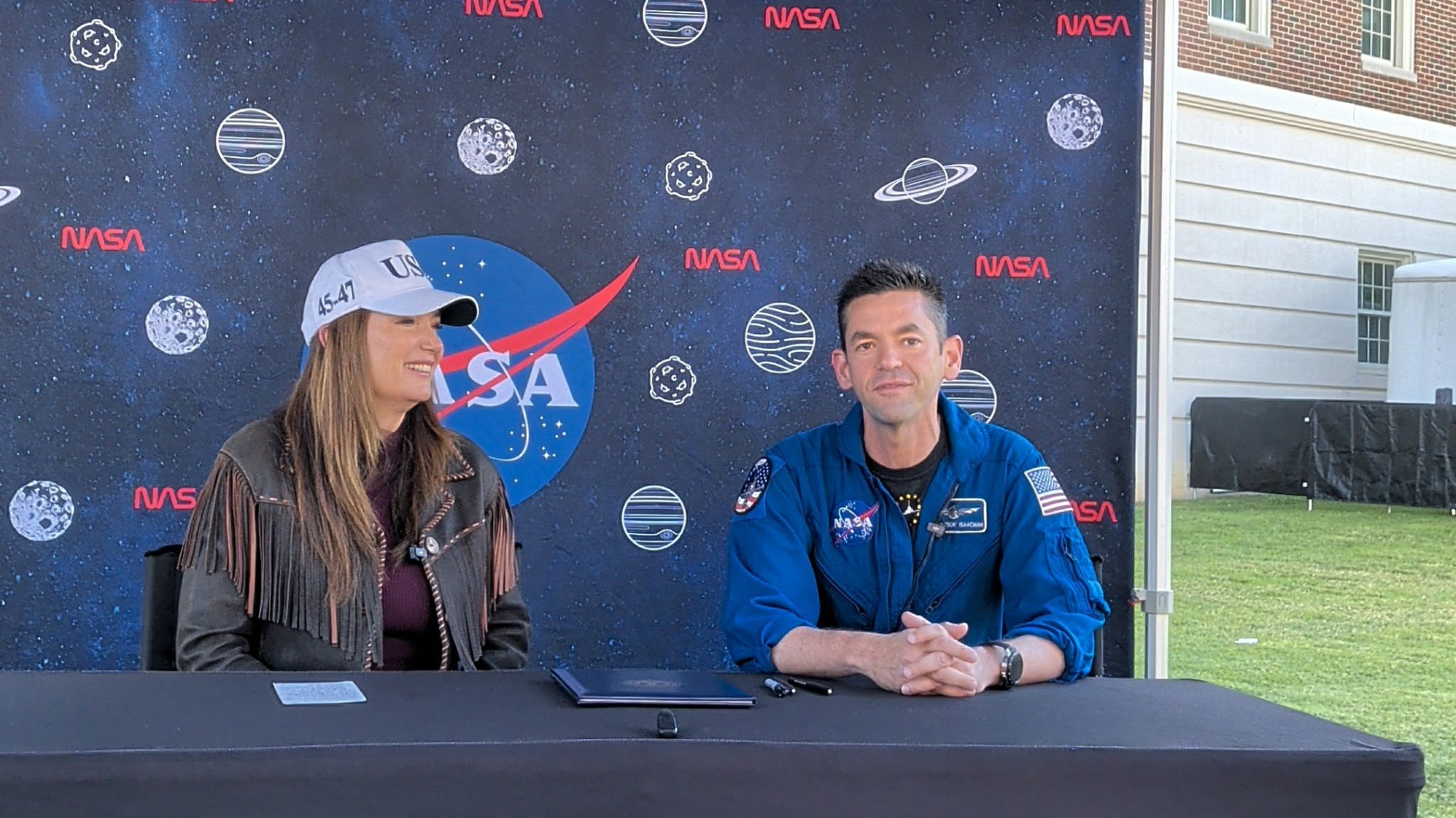
Alabama is among the strong contenders to become home to the proposed U.S. Space Academy, NASA Administrator Jared Isaacman confirmed Saturday in an exclusive interview with 256 Today ahead of the Alabama-Texas A&M football game.
“Oh, I’m quite sure that Alabama is one of the strong contenders right now,” Isaacman said.
The proposed academy, announced by President Donald Trump in August, would be the nation’s first NASA-led federal academy, preparing students for careers in space exploration, engineering, science and national security.
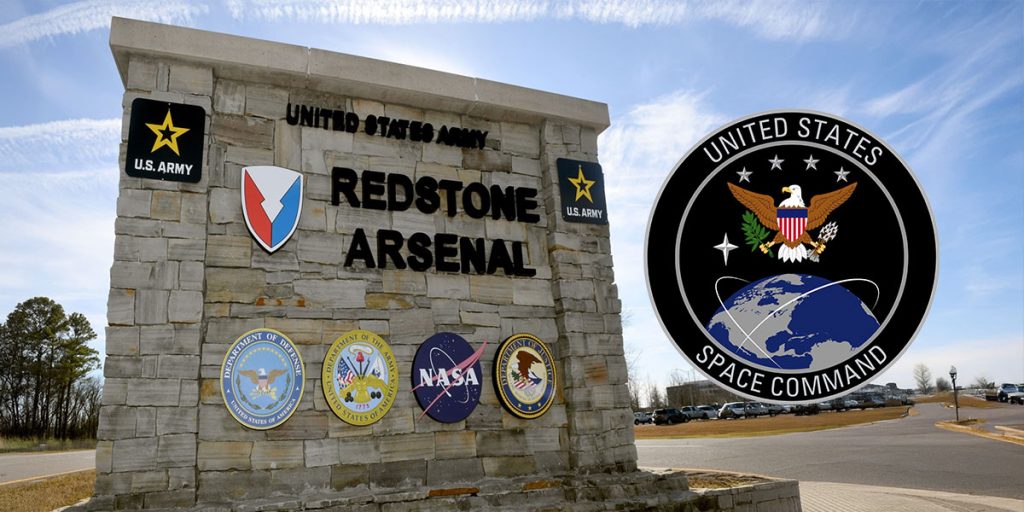
Alabama is making a push to bring the academy to Huntsville, home to NASA’s Marshall Space Flight Center, Redstone Arsenal and a growing aerospace and defense industry.
Isaacman said states with strong ties to the nation’s space program have been reaching out to the commission overseeing the academy’s development.
“So over the last several weeks, you’ve had senators and governors from a lot of states, especially with states with such strong history and space related equities like you have here in in Alabama that have been reaching out,” he said.
He explained that the commission is gathering information about available land and nearby academic institutions that could help educate students before a permanent campus is completed.
“So of course, Alabama was in there,” Isaacman said.
The final location will be selected by President Trump following recommendations from the commission due in December.
What’s next for the Space Academy?
NASA Deputy Administrator Matt Anderson also spoke exclusively with 256 Today, offering additional details about the academy’s timeline and how it would operate.
Anderson said the commission is about halfway through its 120-day assignment and expects to receive information from interested states by Nov. 16. A full commission meeting is scheduled for Nov. 23 to review the submissions and move toward recommendations for the president. The deadline was originally Oct. 26 but was extended to give states additional time to respond.
The timeline calls for groundbreaking on a permanent campus no later than 2027, an initial class of approximately 300 students in temporary facilities in 2028 and a permanent campus operating by 2031.
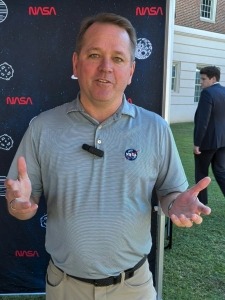
Anderson said the ambitious schedule is achievable, pointing to the establishment of the U.S. Air Force Academy more than 70 years ago.
“And the president signed legislation in April of 54 to establish the US Air Force Academy. 15 months later, summer of 55, students showed up in class,” he said. “So we’re actually have a head start on them from over 70 years ago. So we feel we have plenty of time.”
Unlike traditional military service academies, the U.S. Space Academy would primarily prepare students for civilian service, including careers at NASA and other federal space agencies.
“It is a NASA LED federal Academy,” Anderson said.
“This allows the majority of our graduates to serve their nation in a civilian capacity in NASA or the NRO or other federal space based agencies.”
Students who want to pursue military service would also have an opportunity to earn commissions, primarily in the U.S. Space Force.
Who will attend the academy?
While admissions requirements are still being developed, Isaacman said the academy will look for students with a passion for exploration and a wide range of interests.
“Oh, we are looking for very inspired dreamers about a wonderful future that we can build among the stars right now,” Isaacman said.
“And that will cover a spectrum from your your software engineers, Mechanical Engineers, electrical engineers, aerospace enthusiasts, I mean medical professionals.”
Isaacman said the challenges of establishing a lasting human presence beyond Earth will require expertise in fields that extend well beyond building rockets.
“It’s a very different environment on the on the human body and space. If we’re putting people on the moon building and enduring presence and outposts on another world, we’re going to need a lot of medical professionals on the way,” he said.
He compared the range of skills needed to those required to operate a remote research station.
“So I think if you imagine all the folks that might contribute to a Antarctic research station someday, which covers a whole field of specialties, that’s the kind of people that were going to want to grow up,” Isaacman said.
“But I’ll tell you having that kind of fire right now, that passion for exploration is going to be the best candidate.”
NASA and USDA team up
The interviews followed the signing of a memorandum of understanding between Isaacman and U.S. Secretary of Agriculture Brooke Rollins at the University of Alabama.
The agreement expands cooperation between NASA and the U.S. Department of Agriculture to use satellite observations, advanced technology and data analysis to improve crop forecasts and help farmers prepare for droughts and other natural hazards.
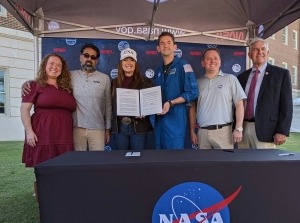
“It’s one of the greatest synergies that comes together when agriculture and NASA put our minds together,” Isaacman said.
Rollins emphasized the national security implications of the partnership, saying food security is national security.
“And I talk a lot about how if we can’t feed ourselves, or fuel ourselves, we will no longer know freedom,” Rollins said.
A little space, a little football
Saturday’s visit was part of NASA’s nationwide Inspiration Tour, which brought space exhibits and NASA personnel to The University of Alabama campus. With stops across the nation, the tour will culminate in MAX POWER, a public exposition of American air and space innovation, Nov. 7 and 8, at the agency’s Kennedy Space Center in Florida.
Supported by Huntsville’s Marshall Space Flight Center, the NASA Experience Zone outside the stadium gave football fans a chance to explore the Artemis program, lunar landing systems and future careers in space.
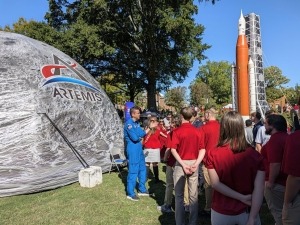
Isaacman said the Alabama-Texas A&M matchup was a natural fit for NASA, with Marshall Space Flight Center in Huntsville and Johnson Space Center in Houston both playing major roles in the nation’s space program.
“This is like one of our Super Bowls right now,” Isaacman said.
Before taking to the skies, Isaacman obliged a “Roll Tide,” while Rollins, a proud Texas A&M graduate, offered a “Gig ’em” for her Aggies.
Shortly after the national anthem and just before kickoff, Isaacman piloted one of three NASA F-5 fighter jets over Bryant-Denny Stadium, with Rollins riding along as his “copilot.” The jets roared low over the stadium in a breathtaking flyover that shook the stands and drew a thunderous roar from the crowd.
View this post on Instagram
As the competition to host the U.S. Space Academy moves forward, the state that helped send Americans to the moon is now in the running to help educate the next generation who will take them even farther.
Got a tip for OTR? Send your tip to [email protected] with related photo/video, your name, phone number, and e-mail address.