The conference room at the Embassy Suites in Huntsville isn’t exactly what you’d expect for headline-making defense news.
But on Monday afternoon, it was packed with announcements from Lockheed Martin about the systems, technologies and production lines being developed in Huntsville and across the country.
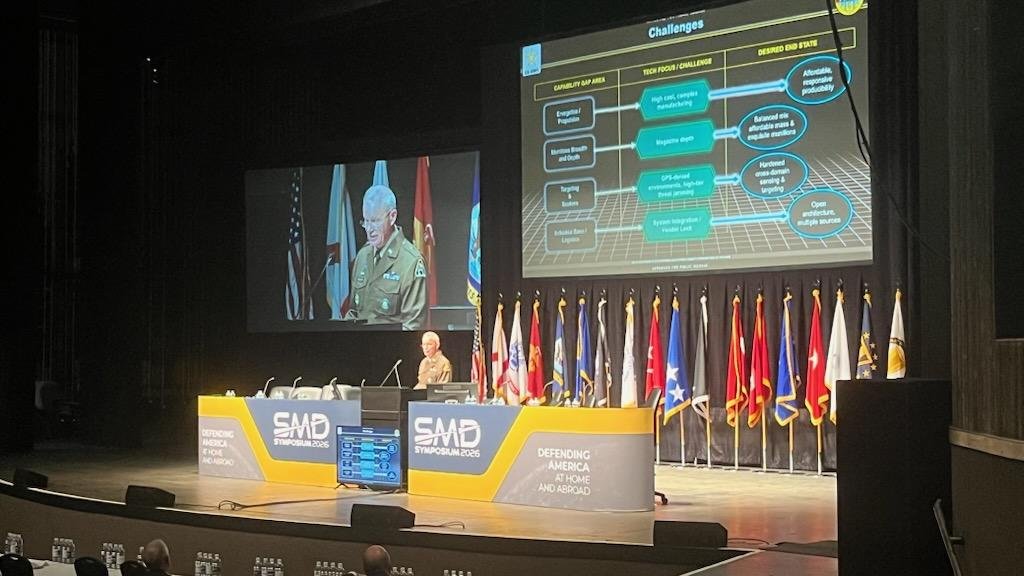
Surrounded by reporters from national defense publications and a handful of local outlets, Lockheed Martin executives used the eve of the 2026 Space and Missile Defense Symposium to roll out a series of announcements spanning missile defense, hypersonics, space systems, production capacity and simulation technology.
The common theme was speed: developing, testing and producing new capabilities faster as the U.S. military works to strengthen what the company repeatedly called the “arsenal of freedom.”
For Huntsville, the announcements included new investment in local missile production, progress on the Missile Defense Agency’s Next Generation Interceptor and a broader push to move emerging technologies from laboratories into operational systems.
“We’re committed to partnerships, production and innovation,” said Jonathan Caldwell, vice president and general manager of Lockheed Martin’s Strategic and Missile Defense Systems.
Investing ahead
Caldwell said Lockheed Martin has committed more than $8 billion to modernize and expand factories across the company while increasing investments in research, development and partnerships.
Todd Stevens, vice president of mission strategy and advanced capabilities for Lockheed Martin Space, said the company has invested roughly $1 billion in space research and development since 2024, including more than a dozen operational space demonstrations.
The goal is to test technologies early, learn quickly and reduce the risk of waiting until a system is fully developed before discovering whether it works.
“We’re going to test early, we’re going to learn very fast,” Stevens said.
Lockheed Martin said it remains committed to demonstrating a space-based interceptor by 2028 and plans a flight test of its next-generation glide body in 2027.
The company also announced a modular payload adapter designed to allow existing hypersonic missile technologies to accommodate different payloads and missions without requiring an entirely new missile system.
Lockheed Martin is also partnering with Albany Engineered Composites to accelerate hypersonic manufacturing, combining Lockheed Martin’s system integration capabilities with Albany’s composite manufacturing expertise.
A major North Alabama role
One of the most significant announcements for North Alabama involved Lockheed Martin’s missile defense operation.
The company highlighted more than $2 billion in planned investments through 2030 at facilities including its Huntsville operations, Courtland and Waterton Canyon in Colorado. About half of that investment is tied directly to production ramps for systems including the space-based interceptor, Conventional Prompt Strike and Next Generation Glide Body.
Lockheed Martin also highlighted the opening of its 88,000-square-foot Missile Assembly Building 5, or MAB-5, in Courtland.
The facility was purpose-built to support production of the Next Generation Interceptor, the Missile Defense Agency’s future homeland missile defense system.
Lockheed Martin said the facility incorporates digital tools and automated workflows designed to increase production capacity as the program moves toward critical design review and initial production.
The company said NGI remains on track for initial production in late 2027 and fielding in 2030.

The effort also involves L3Harris Technologies, Lockheed Martin’s primary propulsion and control systems provider for NGI.
During Monday’s briefing, Lockheed Martin announced the successful first static-fire test of the interceptor’s second-stage motor. L3Harris separately sent an announcement on Monday that it had completed a full-duration hot-fire test of the same stage-two advanced large solid rocket motor in a simulated high-altitude, vacuum environment.
“NGI is critical to the security of the United States and will serve as a cornerstone of our homeland missile defense once deployed,” said Scott Alexander, president of Propulsion Systems, Missile Solutions at L3Harris. “This successful hot-fire test demonstrates L3Harris’ commitment to delivering dependable, high-performance propulsion systems, and we will continue to execute to support NGI’s first flight test.”
The test generated performance data ahead of additional testing later this year.
L3Harris produces both the stage-one and stage-two solid rocket motors for NGI, as well as the attitude control and divert-and-attitude control systems. Its advanced solid rocket motors are manufactured in Alabama and Arkansas, adding another Alabama connection to the program’s growing industrial base.
Building systems
Another major announcement came from Lockheed Martin’s Sensors and Global Sustainment business, which introduced Strigo, a new family of radio frequency sensors, missile data links and seeker technologies.
Stacy Kubicek, vice president and general manager of the business, said Strigo represents a different approach to defense development: investing in technology before the military has formally defined the requirement.
The company said technology developed through the Strigo effort has already informed the PrSM Increment 2 seeker, compressing a process that traditionally could take years into months.
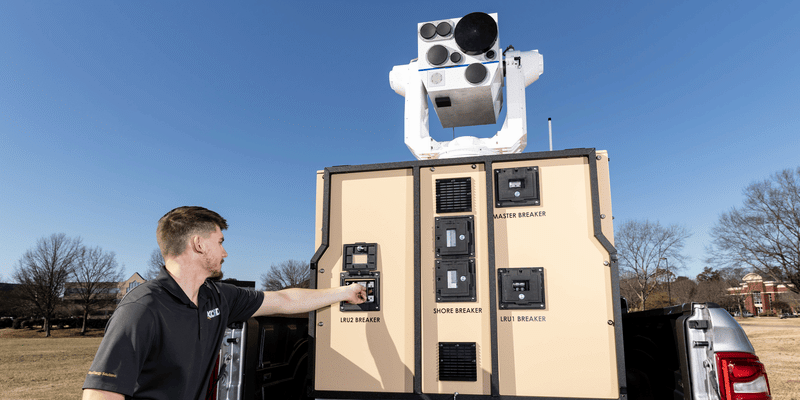
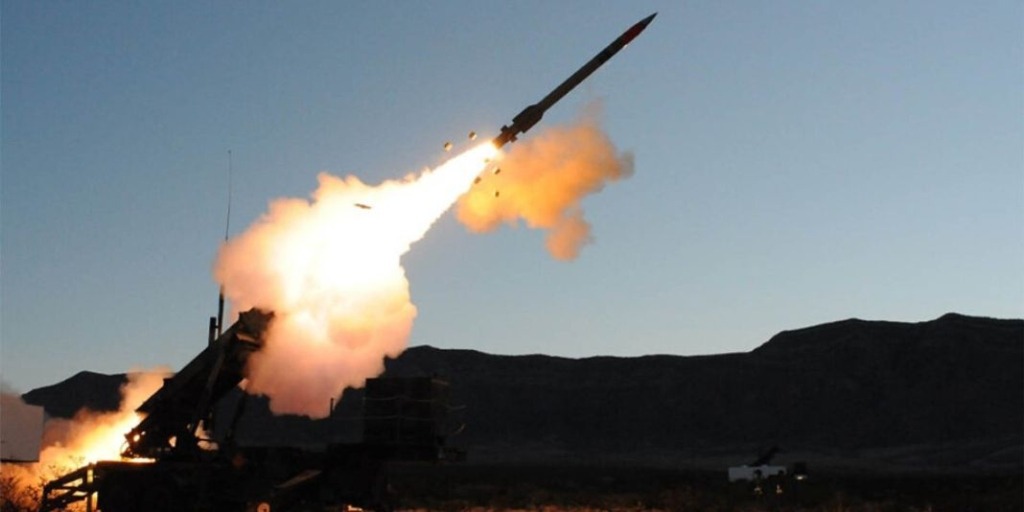
Vice President and General Manager of Integrated Air and Missile Defense Jason Reynolds, outlined additional efforts, including new approaches to PAC-3 production, a sensor and communications capability designed to provide 360-degree coverage and the Grizzly containerized launcher.
Reynolds said Lockheed Martin and its partners integrated Grizzly with other systems and conducted a successful live-fire interception of a Shahed-style drone threat in less than six months.
The company also said it has increased its workforce supporting weapons acceleration by more than 60% over the past decade.
Modeling the battlefield
The final announcement focused less on hardware and more on what happens before hardware reaches the battlefield.
Lockheed Martin showcased its Advanced Center for Experimentation and Simulation, or ACES, a multi-domain modeling and simulation environment designed to help military commanders test defense architectures before deploying them.
The system can model more than 1 million entities at up to 10 times speed, according to Lockheed Martin, allowing users to rapidly test combinations of sensors, weapons, communications, cyber capabilities and space assets.
During the briefing, executives demonstrated two scenarios. In the first, a combination of drones, cruise missiles, ballistic missiles and cyberattacks overwhelmed a defensive architecture.
The second added short-range air defenses, space-based sensing and stronger cyber defenses. The result was dramatically different, with the system able to defeat the simulated threats.
Lockheed Martin said Sweden and the Czech Republic are among the newest ACES customers and that the company was selected for a down-select under a NATO modeling and simulation contract.
The announcements offered a look at how Lockheed Martin is approaching the defense buildup from multiple directions: invest before the requirement arrives, test earlier, expand production and use data and simulation to shorten the path from an idea to a fielded capability.
For a Huntsville audience accustomed to hearing about the systems built and tested across North Alabama, Monday’s briefing offered a glimpse at the machinery behind that buildup, and the push to make it move faster.
Got a tip for OTR? Send your tip to [email protected] with related photo/video, your name, phone number, and e-mail address.